

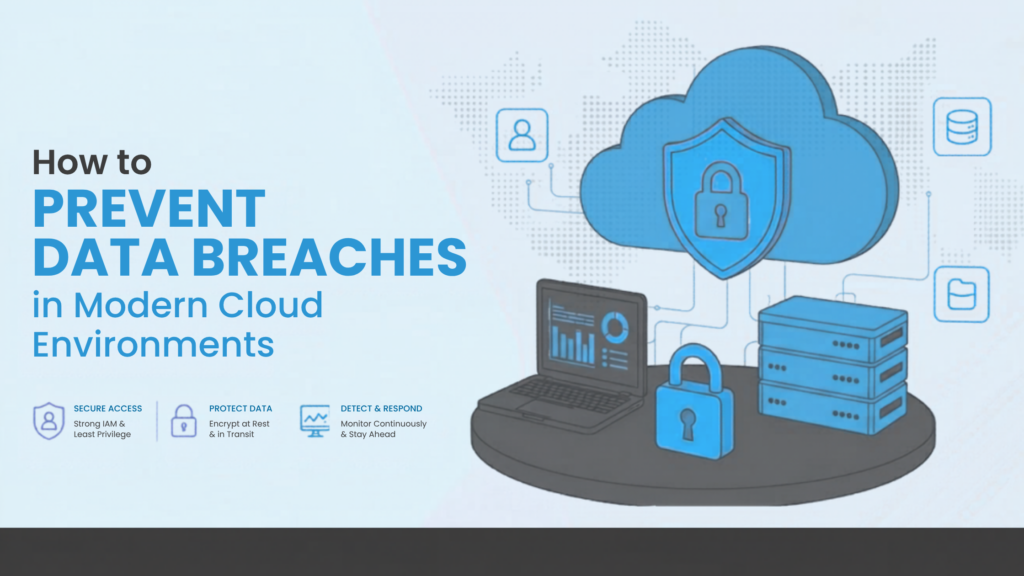
Prevent data breaches in cloud environments is a top priority for organizations using AWS, Azure, and Google Cloud. As cyber threats evolve, businesses must implement strong cloud security strategies to protect sensitive data, maintain compliance, and reduce security risks.
Your company’s sensitive data is living in the cloud—customer information, financial records, and intellectual property. It’s convenient. It’s scalable. But here’s the uncomfortable truth: data breaches happen every single day, and many of them are entirely preventable.
The scary part? Most cloud data breaches don’t result from sophisticated hacking. They result from simple mistakes. A misconfigured storage bucket. Weak access controls. Missing encryption. The kind of oversights that happen when teams move fast and prioritize feature development over security.
At EVERITE Solutions, we work with CTOs, CISOs, and IT leaders who understand that cloud security isn’t optional. Protecting your data in the cloud requires a proactive approach—not just hoping breaches won’t happen to you.
This guide walks you through the most critical prevention strategies. Whether you’re using AWS, Azure, or Google Cloud, these principles apply. Let’s start with the hard truth about what causes breaches in the first place.
⚠️ The Reality of Cloud Breaches
According to industry data, misconfigured cloud resources cause 80% of cloud data breaches. That’s not a vulnerability in the cloud platforms themselves—that’s human oversight. The good news? These breaches are almost entirely preventable with the right practices.
Why Cloud Breaches Happen: The Root Causes
Before you can prevent something, you need to understand how it happens. Cloud data breaches typically stem from a few predictable causes that we see repeatedly across organizations.
Misconfigured Storage: Your Biggest Vulnerability
Imagine leaving your office building unlocked overnight, not because someone forced the door, but because you accidentally set the alarm wrong. That’s what misconfigured cloud storage looks like.
Storage buckets in Amazon S3, Azure Blob Storage, or Google Cloud Storage are often left publicly accessible by default. Attackers don’t even need sophisticated tools—they can find these exposed buckets through simple automated scans. We’ve seen cases where terabytes of sensitive customer data were exposed simply because someone clicked the wrong checkbox during setup.
Identity and Access Management (IAM) Failures
IAM is supposed to be your gatekeeper. It decides who can access what. But when IAM is poorly configured, it becomes your weakest point.
Common problems include:
- Over-permissive roles: Giving users more access than they need
- Shared credentials: Multiple people using the same password or API key
- Forgotten access: Accounts that should have been revoked months ago
- Default policies: Never reviewing or updating the policies that came with your deployment
Each of these creates an opportunity for attackers or malicious insiders to escalate privileges and access sensitive data.
The Human Factor: Insider Threats and Errors
Not every breach comes from external attackers. Sometimes the threat is internal—either intentional (disgruntled employees) or accidental (phishing emails, social engineering).
An employee with excessive access rights can exfiltrate data intentionally. Or someone with good intentions might fall for a phishing attack, giving attackers the credentials they need. Human error accounts for a significant percentage of breaches, which is why security training matters more than you might think.
Unprotected APIs and Endpoints
Modern cloud environments are built on APIs. But APIs without proper authentication, rate limiting, or input validation become gateways for attackers. A vulnerable API endpoint can expose entire databases.
Lack of Visibility and Monitoring
Here’s a frightening statistic: the average time to detect a cloud data breach is 210+ days. Imagine an attacker having access to your systems for seven months before you even know they’re there.
Without continuous monitoring and logging, you’re essentially flying blind. You won’t know what suspicious activity is happening until it’s too late.
Is Your Cloud Environment Secure?
EVERITE can audit your cloud infrastructure for misconfigurations, vulnerabilities, and compliance gaps. Get professional insights into your security posture.
Schedule a Free Security Audit Learn More About Cloud Security
Prevention Strategies That Actually Work
Now that you understand the risks, let’s talk about concrete prevention strategies. These are proven approaches that dramatically reduce your breach risk.
1. Implement the Principle of Least Privilege
The principle of least privilege means: give people access to exactly what they need—nothing more. Not what might be useful someday. Not what’s convenient. Just what they need to do their job today.
This requires:
- Role-based access control (RBAC): Assign permissions based on job roles, not individual preferences
- Regular access reviews: Quarterly audits of who has access to what
- Immediate revocation: When someone leaves, remove their access immediately
- Service accounts: Never share credentials; each service gets its own authenticated identity
2. Encrypt Everything: At Rest and in Transit
Encryption is your safety net. Even if an attacker breaches your systems, encrypted data is useless to them without the encryption keys.
Implementation essentials:
- Data at rest: Use AWS KMS, Azure Key Vault, or Google Cloud KMS to encrypt stored data
- Data in transit: Enforce TLS 1.2+ for all communications between clients and your cloud systems
- Key management: Rotate encryption keys regularly and store them securely
- Database encryption: Enable native encryption features at the database level
3. Enforce Multi-Factor Authentication (MFA) Everywhere
A password alone isn’t enough anymore. Multi-factor authentication—requiring a second form of verification—dramatically reduces the risk of account compromise.
Enforce MFA for:
- All user accounts accessing cloud consoles
- Administrative accounts (non-negotiable)
- API keys and service accounts (where supported)
- VPN and remote access points
4. Implement Continuous Monitoring and Logging
You can’t defend against threats you can’t see. Implement comprehensive logging and set up alerts for suspicious activities:
- CloudTrail (AWS), Azure Monitor, Cloud Audit Logs (GCP): Log all API calls and changes
- Real-time alerts: Set up notifications for unusual login patterns, data transfers, or permission changes
- Centralized logging: Aggregate logs from all sources into a single platform for analysis
- Regular log reviews: Don’t just collect logs; analyze them
5. Adopt Zero Trust Architecture
Zero Trust architecture assumes nothing is inherently trustworthy. Not your employees. Not your network. Not your cloud environment. Every access request must be verified.
This means:
- Identity verification for every access request
- Micro-segmentation (isolating systems from each other)
- Continuous validation of trust status
- Limited lateral movement if an attacker gains access
6. Secure Your APIs and Endpoints
Every API is a potential entry point. Protect them with:
- Strong authentication (OAuth 2.0, API keys)
- Rate limiting to prevent brute force attacks
- Input validation to prevent injection attacks
- Web Application Firewalls (WAF) to filter malicious traffic
- Regular vulnerability testing and patching
7. Regular Security Audits and Penetration Testing
You can’t fix what you don’t know about. Regular audits and penetration tests help identify vulnerabilities before attackers do:
- Automated scanning: Continuous assessment for misconfigurations
- Manual penetration testing: Simulated attacks to test your defenses
- Quarterly audits: Minimum frequency for most organizations
- Compliance assessments: Ensure you meet industry standards (SOC 2, ISO 27001, etc.)
Tools and Technologies That Help
The major cloud providers offer excellent native security tools. Don’t underestimate them:
| Cloud Provider | Key Security Tools | Primary Purpose |
| AWS | IAM, KMS, CloudTrail, GuardDuty, Security Hub | Comprehensive identity, encryption, and threat detection |
| Azure | Azure AD, Key Vault, Security Center, Sentinel | Integrated identity and threat response |
| Google Cloud | Cloud IAM, Cloud KMS, Cloud Audit Logs, SCC | Centralized identity and security posture management |
Beyond native tools, consider specialized solutions like Cloud Security Posture Management (CSPM) platforms, which continuously scan for misconfigurations and compliance violations.
Quick Wins You Can Implement Today
Don’t wait for a comprehensive security overhaul. Start with: (1) Enable MFA on all admin accounts, (2) Review IAM permissions for over-privileged roles, (3) Enable encryption for your most sensitive data, (4) Set up basic monitoring alerts. These four actions eliminate the majority of common vulnerabilities.
Frequently Asked Questions
What’s the single biggest cause of cloud data breaches?+
Misconfigured cloud resources, particularly storage buckets left publicly accessible. This accounts for roughly 80% of preventable breaches. The second most common cause is weak IAM policies that grant excessive permissions.
How often should I audit my cloud security?+
Minimum: quarterly for most organizations. However, continuous automated monitoring is ideal. Critical infrastructure and sensitive data should be reviewed more frequently—monthly or even weekly for high-risk environments.
Is cloud storage secure by default?+
No. Cloud providers secure the infrastructure, but you’re responsible for configuration. Default settings often prioritize ease-of-use over security. Always explicitly configure access controls and encryption for your data.
What’s the difference between shared responsibility and my responsibility?+
The cloud provider secures the infrastructure (servers, networking, facilities). You secure everything on top: data, applications, IAM, encryption keys, and access controls. Understanding this boundary is critical—gaps here cause most breaches.
How can I detect a breach if I’m already compromised?+
Continuous monitoring is your best defense. Look for: unusual login patterns, unexpected data transfers, permission changes, or anomalous API activity. Tools like CloudTrail and Azure Monitor can alert you to these indicators. If you suspect a breach, engage a professional incident response team immediately.
Should I be using Zero Trust architecture?+
Yes, especially for cloud environments. Zero Trust significantly reduces breach impact by limiting lateral movement and enforcing strict verification. Start with micro-segmentation and identity verification, then expand from there.
Your Cloud Security Checklist
✓ Essential Prevention Measures
- IAM policies enforcing least privilege with regular access reviews
- Encryption is enabled for all data at rest and in transit
- Multi-factor authentication is required for all accounts
- Continuous monitoring with real-time alerting in place
- Regular security audits and penetration testing are scheduled
- Backup procedures tested and isolated from production
- API endpoints secured with authentication and rate limiting
- Incident response plan documented and communicated
- Security training is provided to all employees
- Zero Trust principles implemented across the infrastructure
Secure Your Cloud Environment Today
EVERITE Solutions specializes in cloud security audits, architecture review, and implementation of proven prevention strategies. Let’s make sure your data is protected.
Get Your Cloud Security Assessment →
About EVERITE Solutions
EVERITE Solutions helps organizations secure their cloud infrastructure across AWS, Azure, and Google Cloud. We conduct comprehensive security audits, implement best practices, and ensure your data is protected. From cloud solutions and infrastructure to security imperative protection, we’re your partner in building a secure cloud environment. Contact us today to discuss your security needs.
cloud software solution