The reality for the modern enterprise is that technology is no longer just a support function; it is the organization’s central nervous system. Every minute of unplanned downtime costs thousands in lost productivity, damaged brand reputation, and missed revenue opportunities. The risk of operating on legacy infrastructure or relying on reactive “break-fix” support models is no longer just a technical concern—it is a fundamental business threat.
For years, many organizations operated under the assumption that if the lights were on and the servers were humming, the IT strategy was successful. However, as digital environments become increasingly complex and security threats more sophisticated, these traditional models have reached their breaking point. To remain competitive, decision-makers are shifting toward a more strategic approach: Managed IT services combined with deep AI and IT integration. This evolution represents a move toward AI-driven IT solutions that prioritize foresight over recovery and strategy over maintenance.
What is Managed IT?
Managed IT is a proactive approach to managing and maintaining IT systems to ensure security, reliability, and smooth day-to-day operations.
What is AI Integration?
AI integration is the process of embedding artificial intelligence into systems to automate tasks, improve efficiency, and support smarter decision-making.
How the Real IT Challenges Businesses Face Today
Operational leaders and CIOs are currently navigating a landscape defined by high volatility and mounting technical debt. While digital transformation promised a world of seamless efficiency, the practical experience for many businesses is fraught with persistent pain points.
Slow Systems and Constant Downtime
Even minor latency in cloud applications or internal networks can aggregate into significant annual losses. When systems are slow, employee output drops and customer frustration rises. Without a dedicated management layer, these performance bottlenecks often go undiagnosed for weeks, treated as minor nuisances until they snowball into a total system failure.
Reactive IT Support
In a reactive model, the IT team is constantly in “firefighting” mode. This means that by the time a ticket is raised, the damage has already occurred. This cycle prevents IT staff from focusing on high-level strategy, keeping them trapped in a loop of solving the same recurring problems rather than addressing the root causes.
Manual Processes and Inefficiency
Manual provisioning, password resets, and hardware updates still bog down many IT departments. These repetitive tasks consume valuable hours and are prone to human error. Inconsistent manual configurations often create “shadow IT” or security gaps that are difficult to track and remediate.
Security Risks and Lack of Visibility
As the perimeter of the modern office expands to include remote work and a plethora of mobile devices, visibility becomes a challenge. Without centralized IT management, it is nearly impossible to ensure that every endpoint is patched, every user is authenticated, and every vulnerability is accounted for in real-time.
Why Traditional IT Models Are No Longer Enough
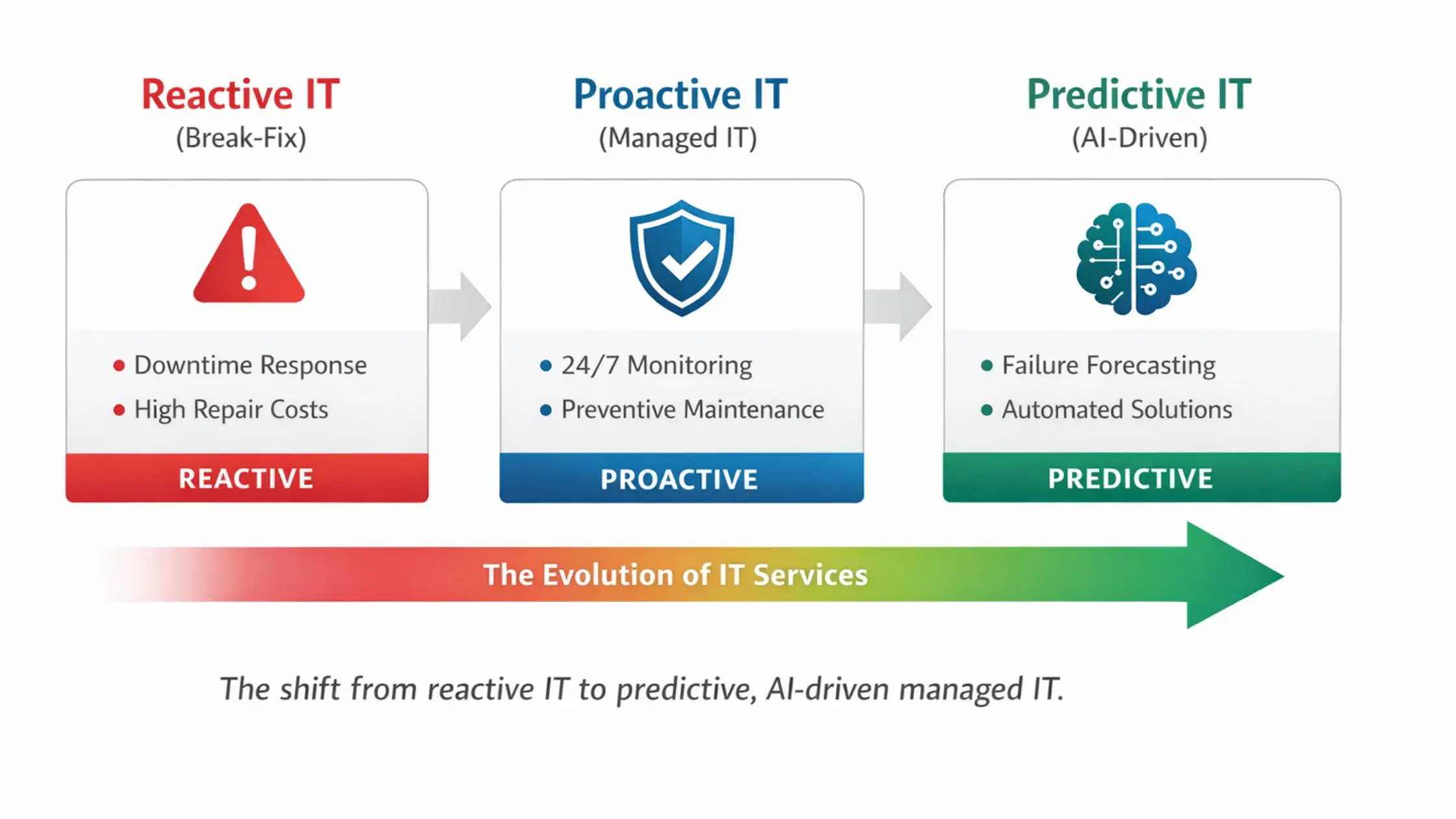
The limitations of the “break-fix” and manual monitoring models are becoming more apparent as data volumes explode. In many traditional setups, monitoring is still threshold-dependent. An alert might trigger only after a server reaches 99% capacity or a network switch fails. By that point, the business is already losing money.
This is why the old reactive model is being replaced by a proactive managed IT approach—and now, increasingly, by predictive IT powered by AI. Instead of responding after disruption, modern IT is designed to prevent issues early and forecast failures before they occur.
Furthermore, the increasing complexity of modern IT environments—blending on-premises infrastructure with multi-cloud architectures—makes manual oversight unsustainable. Human teams, no matter how skilled, cannot monitor millions of data points across a global network 24/7. That gap between the speed of digital business and the limits of manual oversight is where the most significant operational risks reside.
What Managed IT with AI Integration Means
To modernize effectively, we must define the synergy between human expertise and machine intelligence. Managed IT services involve a strategic partnership in which an external provider assumes responsibility for maintaining, securing, and optimizing an organization’s IT functions.
When we introduce AI and IT integration into this framework, the model shifts from human-led monitoring to machine-supported intelligence. AI in this context refers to machine learning algorithms and advanced data analytics applied to the “telemetry”—the health signals—of your entire infrastructure.
By integrating AI, managed services can process vast amounts of log data to identify patterns that a human eye would miss. It improves decision-making by providing actionable insights, such as determining which hardware is likely to fail in the next quarter or which network nodes are experiencing unusual traffic patterns that might indicate a breach.
Centralized IT Management: Visibility Without Complexity
One of the primary benefits of modern managed services is the consolidation of the IT stack. Centralized IT management provides a “single pane of glass” view into the entire organization’s health, from the headquarters’ data center to a remote employee’s laptop.
- Unified Security: Security patches and software updates are pushed simultaneously across all devices, ensuring no “weak links” remain in the network.
- Compliance and Governance: In industries with strict regulatory requirements, centralized logging and reporting simplify processes, improve accuracy, and reduce audit time.
- System Visibility: Decision-makers gain access to real-time performance metrics, enabling data-backed decisions on hardware lifecycle and infrastructure investments.
AI-Enhanced IT Automation: Eliminating Inefficiency
The integration of IT automation is the most immediate way to see a return on investment. AI-powered IT support tools can handle the high-volume, low-complexity tasks that typically clog helpdesk queues and frustrate employees.
For example, an AI-driven system can automate access management. When a new employee joins, the system can automatically provision the necessary software licenses, email accounts, and network permissions based on their specific role. Similarly, AI can handle automated software deployments and system updates during off-hours, ensuring that the workday remains uninterrupted. By eliminating these repetitive manual tasks, the organization reduces the margin for error and allows internal teams to focus on high-impact projects.
Predictive IT Maintenance: Preventing Disruption
The most significant shift in modern IT is the move from proactive to predictive IT maintenance. While proactive services involve regular scheduled check-ups, predictive services use AI to forecast specific points of failure based on historical data and real-time trends.
By continuously monitoring hardware temperature, disk read/write speeds, and network latency, AI-driven IT solutions can flag a failing component days or weeks before it actually crashes. This allows for “zero-downtime” maintenance, where parts are replaced or systems are migrated during scheduled windows rather than in an emergency. This level of foresight is what separates market leaders from those constantly struggling with technical instability.
Smarter Resource Allocation and Scalable Growth
Managed IT is often viewed as a technical decision, but it is fundamentally a financial and strategic one. By leveraging an external partner for IT infrastructure management, companies can shift from a capital-intensive expenditure model to a more predictable operational model.
Freeing Internal Teams for Innovation
Internal IT staff are often highly skilled individuals whose time is best spent on digital transformation and product innovation. When they are freed from the burden of daily maintenance, password resets, and user support, they can contribute directly to the company’s strategic goals and revenue-generating initiatives.
Supporting Scalable Growth
As a business grows, its IT needs do not just increase; they multiply. An AI-integrated managed service scales effortlessly. Whether you are adding ten employees or opening a new international branch, the centralized management framework ensures that the new infrastructure is integrated seamlessly without the need for a massive increase in internal headcount.
Business Benefits Beyond Technology
The value of business IT optimization extends into every department of the company. When IT works as intended, the entire organization benefits from:
- Cost Optimization: Reducing the high costs associated with emergency repairs, lost productivity, and redundant software subscriptions.
- Reliability and Uptime: Ensuring that digital storefronts and internal tools are always available for customers and staff, regardless of the load.
- Enhanced Security posture: Utilizing AI to detect anomalies that may indicate a cyberattack, often neutralizing threats before they can exfiltrate data.
- Competitive Advantage: Companies with lean, efficient, and modern IT stacks can pivot faster and adopt new technologies more quickly than those bogged down by legacy systems.
When Is the Right Time to Adopt AI-Driven Managed IT?
Many leaders wonder if their organization is “ready” for AI integration. The reality is that if you are waiting for the perfect moment, you are likely already falling behind. Readiness indicators include:
- Maintenance Dominance: Your IT team spends more than 50% of their time on maintenance and “firefighting” rather than new projects.
- Recurrent Downtime: Unplanned outages have occurred more than once in the last six months, impacting operations.
- Lack of Visibility: You lack a clear, centralized view of your hardware assets, their age, and their security patch status.
- Growth Friction: Scaling your operations feels hampered by your current technical limitations or the time it takes to set up new users.
A common mistake is waiting for a total system failure to seek a partner. The most successful transitions happen when an organization recognizes that its current IT model is a bottleneck to future growth. Choosing the right partner—one that understands the intersection of traditional reliability and modern AI capabilities—is the most critical step in this journey.
Conclusion
The convergence of Managed IT services and AI-driven IT solutions is not a luxury for the future; it is a necessity for the present. The complexity of today’s digital world has outpaced the capability of manual, reactive IT management. Organizations that continue to rely on outdated models risk not only downtime and data loss but a gradual erosion of their competitive standing in an increasingly digital marketplace.
Modernize Your Infrastructure with Everite Solutions
Navigating the transition to AI-enhanced IT requires a partner with deep technical expertise and a strategic mindset. Everite Solutions specializes in providing proactive IT services that align with your specific business objectives. We help organizations move away from the chaos of reactive support and toward a streamlined, automated, and secure digital future.
Would you like me to prepare a customized IT maturity assessment to identify precisely where AI integration could have the most significant impact on your current operations?