

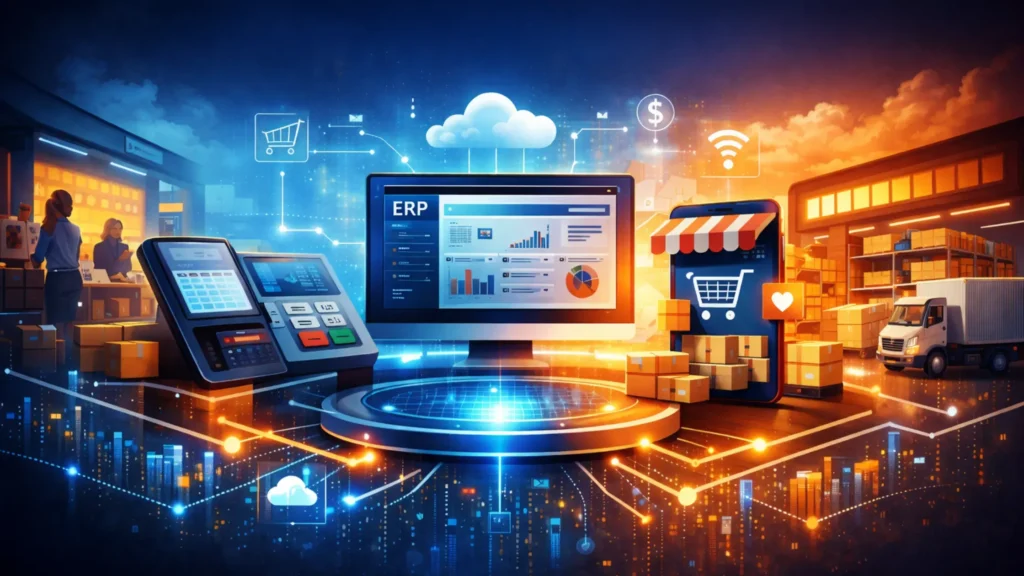
Modern retail is operating in an environment of unprecedented complexity. Brands are expected to deliver seamless experiences across physical stores, eCommerce platforms, marketplaces, mobile apps, and emerging digital channels — all while maintaining operational efficiency and margin control.
As customer expectations rise, so does the volume of transactions, data, and system dependencies. Inventory accuracy must be real-time. Financial reporting must be reliable. Leaders need instant visibility to make confident decisions. This is why unified retail platforms have become essential for retailers looking to scale sustainably.
Yet many retailers still rely on disconnected retail systems.
Legacy POS platforms, standalone ERP systems, isolated eCommerce tools, and fragmented analytics stacks create operational blind spots. As these systems fail to communicate with one another, retailers struggle to scale efficiently.
The reality: retail growth breaks down when systems remain disconnected.
The Hidden Cost of Disconnected Retail Systems
Disconnected systems rarely fail loudly. Instead, they introduce slow, compounding inefficiencies that erode performance over time.
Delayed Insights and Reporting
When retail data is fragmented:
- Sales insights arrive too late to influence decisions
- Financial reporting requires manual consolidation
- Leadership operates with partial or outdated information
Without strong retail data integration, retailers lose agility — a critical disadvantage in competitive markets.
Manual Reconciliation Across POS, ERP, and eCommerce
One of the most common pain points in retail operations is manual reconciliation between systems:
- POS sales don’t align with ERP financials
- Inventory levels vary by platform
- Teams rely on spreadsheets to bridge system gaps
This is where POS ERP integration becomes essential for operational stability.
Inventory Inaccuracies and Demand Blind Spots
Disconnected inventory systems lead to:
- Stockouts that impact customer trust
- Overstock that locks up working capital
- Poor demand forecasting
Retailers without connected retail systems struggle to optimize supply chains and respond to real-time demand signals.
Slower Decision-Making and Operational Drag
Fragmented systems create friction across every function:
- Teams spend more time fixing data than acting on it
- Automation initiatives stall due to unreliable inputs
- Growth increases complexity instead of efficiency
At scale, these inefficiencies compound rapidly.
Why Unified Retail Platforms Are Now Essential
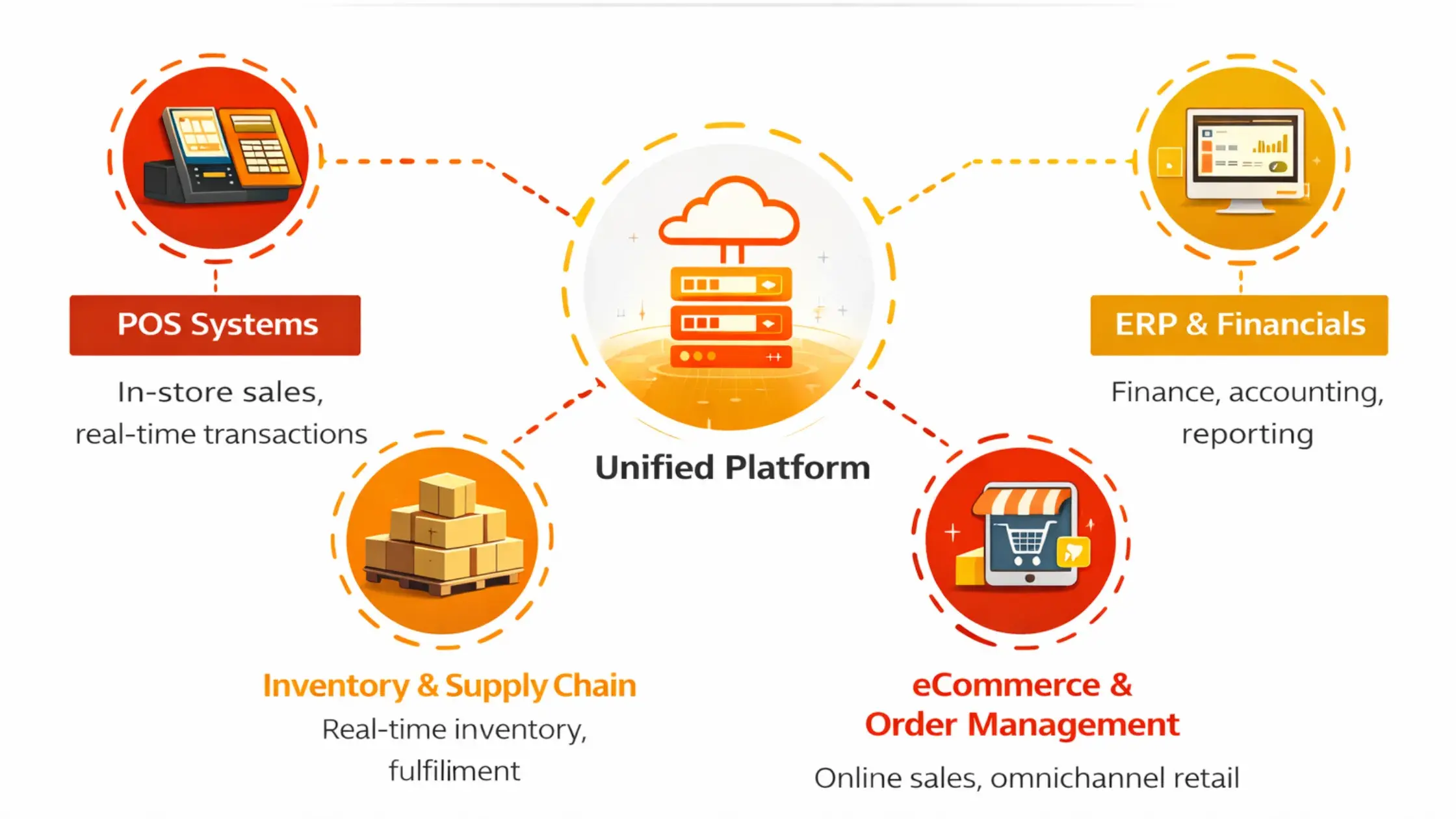
To scale effectively, retailers need more than isolated tools. They need unified retail platforms designed to support growth, visibility, and adaptability.
Real-Time Data Flow Across Systems
Unified platforms enable seamless integration across:
- POS systems
- ERP and financial platforms
- eCommerce and order management
- Supply chain and inventory systems
This creates truly connected retail systems where information flows without friction.
A Single Source of Truth
Retail ERP integration enables a centralized source of truth for:
- Financial reporting
- Inventory and fulfillment
- Operational performance metrics
With reliable data, teams can move faster and with greater confidence.
Faster Response to Market and Customer Behavior
Unified platforms allow retailers to:
- Adjust pricing and promotions in real time
- Respond quickly to demand shifts
- Deliver consistent customer experiences
This responsiveness is a cornerstone of successful retail digital transformation.
A Scalable Foundation for Analytics and Automation
Advanced analytics and AI require clean, connected data. Unified platforms provide:
- Consistent datasets
- Automation-ready workflows
- Predictive insights grounded in reality
Without integration, intelligence initiatives remain limited.
From Fragmented Tools to Connected Retail Architecture
Retail scalability depends on architecture — not just applications.
Moving Away From Siloed Point Solutions
Point solutions solve individual problems but create long-term complexity:
- Overlapping capabilities
- Disconnected data models
- Rising integration and maintenance costs
Connected systems simplify operations while reducing technical debt.
ERP as the Operational Backbone
Modern retail ERP systems act as the core of operations:
- Finance and accounting
- Inventory and procurement
- Order and fulfillment management
- Compliance and controls
Strong retail ERP integration ensures all functions operate in alignment.
Integration Across Commerce, Finance, and Supply Chain
True scalability requires synchronization across:
- Omnichannel retail systems
- Financial reporting and controls
- Supply chain and logistics
This alignment transforms growth from a risk into a capability.
Security, Compliance, and Risk in Connected Retail Systems
As retail operations scale, risk exposure grows alongside them. Disconnected systems significantly increase vulnerability by fragmenting controls and reducing visibility.
Why Disconnected Systems Increase Risk
Retailers operating on disconnected platforms often face:
- Inconsistent access controls
- Duplicate customer and transaction data
- Limited auditability
- Increased exposure to data breaches
These risks intensify as transaction volumes and regulatory requirements grow.
How Unified Platforms Strengthen Governance
Unified retail platforms support stronger governance by enabling:
- Centralized identity and access management
- Consistent security policies across systems
- Clear audit trails for financial and operational data
- Easier regulatory compliance
Robust retail ERP integration plays a critical role in maintaining control as businesses scale.
Omnichannel Growth Requires Connected Retail Systems
Omnichannel retail is now a baseline expectation — not a competitive advantage.
The Omnichannel Challenge Without Integration
Without connected systems, omnichannel strategies struggle:
- Inventory visibility differs by channel
- Orders fail between online and in-store systems
- Returns and exchanges become operationally complex
- Customer data remains fragmented
Disconnected platforms make omnichannel growth expensive and unreliable.
How Unified Platforms Enable Omnichannel Scale
With omnichannel retail systems built on unified platforms, retailers gain:
- Real-time inventory visibility
- Seamless order orchestration
- Unified customer and transaction data
- Consistent pricing and promotions
Connected systems allow retailers to scale across channels without increasing operational friction.
Human-Guided Intelligence in Retail Operations
Automation and AI are only as effective as the data they rely on.
AI Depends on Connected Data
Unified platforms enable:
- Predictive demand forecasting
- Inventory optimization
- Intelligent pricing strategies
Without connected retail systems, AI amplifies errors rather than generating insights.
Human Oversight Builds Trust and Accountability
Retail leaders require:
- Transparent data flows
- Explainable analytics
- Clear accountability
Human-guided intelligence ensures decisions remain aligned with business strategy.
Predictive Insights vs Reactive Firefighting
Disconnected systems force teams into constant reaction.
Unified platforms enable:
- Early issue detection
- Scenario modeling
- Proactive optimization
This shift is critical for sustainable scale.
How Everite Enables Scalable Retail Transformation
Everite positions itself as a capability enabler, helping retailers build connected foundations for growth.
Retail ERP Integration and Modernization
Everite supports retailers by:
- Modernizing legacy ERP environments
- Integrating ERP with POS, eCommerce, and supply chain systems
- Eliminating data silos without disrupting operations
Unified Data and Analytics Frameworks
Through deep retail data integration, Everite delivers:
- Real-time operational dashboards
- Accurate financial reporting
- Enterprise-wide data consistency
Cloud-Ready Enterprise Retail Architecture
Everite designs enterprise retail architecture that is:
- Scalable and cloud-ready
- Secure and compliant
- Flexible enough to evolve with the business
AI-Ready Foundations Embedded in Operations
Rather than layering AI onto fragmented systems, Everite embeds intelligence into connected workflows, enabling practical, trustworthy outcomes.
Frequently Asked Questions (FAQs)
1. What are connected retail systems?
Connected retail systems integrate POS, ERP, eCommerce, and inventory platforms so data flows in real time across operations.
2. Why do disconnected retail systems limit scalability?
They create data silos, manual work, and delayed insights, making it harder to manage growth efficiently.
3. How does retail ERP integration help omnichannel retail?
It ensures accurate inventory, consistent pricing, and seamless order fulfillment across all sales channels.
4. What is a unified retail platform?
A unified retail platform connects core retail systems into a single architecture, providing one source of truth.
5. When should retailers modernize their retail architecture?
When reporting is slow, inventory is inaccurate, or systems no longer support growth and omnichannel needs.
Conclusion:
Retail doesn’t fail to scale because of market conditions or ambition. It fails because its systems aren’t built to grow together.
- Tools alone don’t scale retail
- Disconnected systems create friction and risk
- Manual processes hide inefficiencies
Alignment, integration, and data clarity are what enable speed, resilience, and long-term growth.
Connected retail systems transform complexity into coordination — and coordination into competitive advantage.
👉 Scale with Everite.
👉 Scale retail with connected systems built by Everite.