


Artificial intelligence is rapidly reshaping the education landscape. What began as small-scale experimentation has evolved into broad institutional adoption across regions and education systems worldwide.
Colleges and universities in the United States are using AI to improve enrollment planning, student services, and academic operations. In the Middle East, national digital education programs encourage schools to use AI as part of their long-term modernization efforts.
In Asia, large-scale education systems are integrating AI into operational and administrative workflows at a remarkable speed.
This global acceleration reflects a fundamental shift. AI is no longer viewed as a future investment—it is becoming a present-day operational reality.
However, as AI adoption in education accelerates, many institutions are discovering a critical challenge. Moving fast does not always mean moving forward. Without a clear enterprise strategy, AI initiatives can introduce new risks rather than deliver meaningful progress.
Speed without strategy creates fragmentation, governance gaps, and inconsistent outcomes. Institutions that rush into AI without foundational readiness often struggle to sustain value over time
The most successful institutions are taking a different approach. They are prioritizing structure, alignment, and governance before scaling AI across the enterprise.
The Problem: When AI Simplifies Instead of Strengthening Learning
AI is often introduced to simplify processes, improve efficiency, or enhance learning experiences. Yet in many institutions, AI adoption unintentionally increases complexity.
The reason is fragmentation.
Disconnected AI Across Departments
Many educational institutions adopt AI tools at the departmental level. Admissions teams deploy predictive tools, academic departments test AI-driven learning platforms, student services introduce chatbots, and finance teams rely on separate analytics within education ERP systems.
Each solution may function well on its own. But without coordination, these tools operate in isolation.
Data Silos Across Core Systems
The challenge becomes more serious when AI tools depend on disconnected systems:
- Student Information Systems (SIS)
- Learning Management Systems (LMS)
- Education ERP systems for finance and HR
When these systems do not communicate effectively, AI relies on incomplete or outdated data. As a result, insights become fragmented, and decisions lose consistency.
Institutional Risks of Uncoordinated AI
When AI operates without enterprise alignment, institutions face significant risks:
- Bias and fairness issues due to limited or skewed datasets
- Privacy and compliance challenges from unmanaged data usage
- Inconsistent outcomes across campuses or departments
- Limited trust in AI-generated insights
These risks highlight a critical truth: AI must be governed at the institutional level. AI governance in education is essential to ensure ethical use, regulatory compliance, and consistent decision-making.
AI should not be treated as a collection of tools. It must be managed as an enterprise capability.
The Shift: From Classroom Tools to Enterprise Intelligence
Much of the AI conversation in education has focused on classroom applications. While these tools offer value, they represent only a small part of AI’s potential impact.
The fundamental transformation happens when AI supports enterprise intelligence across the institution.
AI’s Role Beyond Teaching
When supported by unified systems and governed data, AI enables institutions to move beyond isolated use cases and address broader operational challenges.
Key applications include:
- Enrollment forecasting to predict demand and guide recruitment strategies
- Financial planning to improve budgeting accuracy and long-term sustainability
- Workforce optimization to align faculty and staff resources with institutional needs
- Student lifecycle insights to identify risks related to retention and progression
These capabilities demonstrate how AI in higher education operations can support strategic planning and institutional resilience.
However, this shift requires more than advanced algorithms. It depends on systems that can deliver accurate, timely, and consistent data across the organization.
Why Institutions Need Unified Systems to Support AI
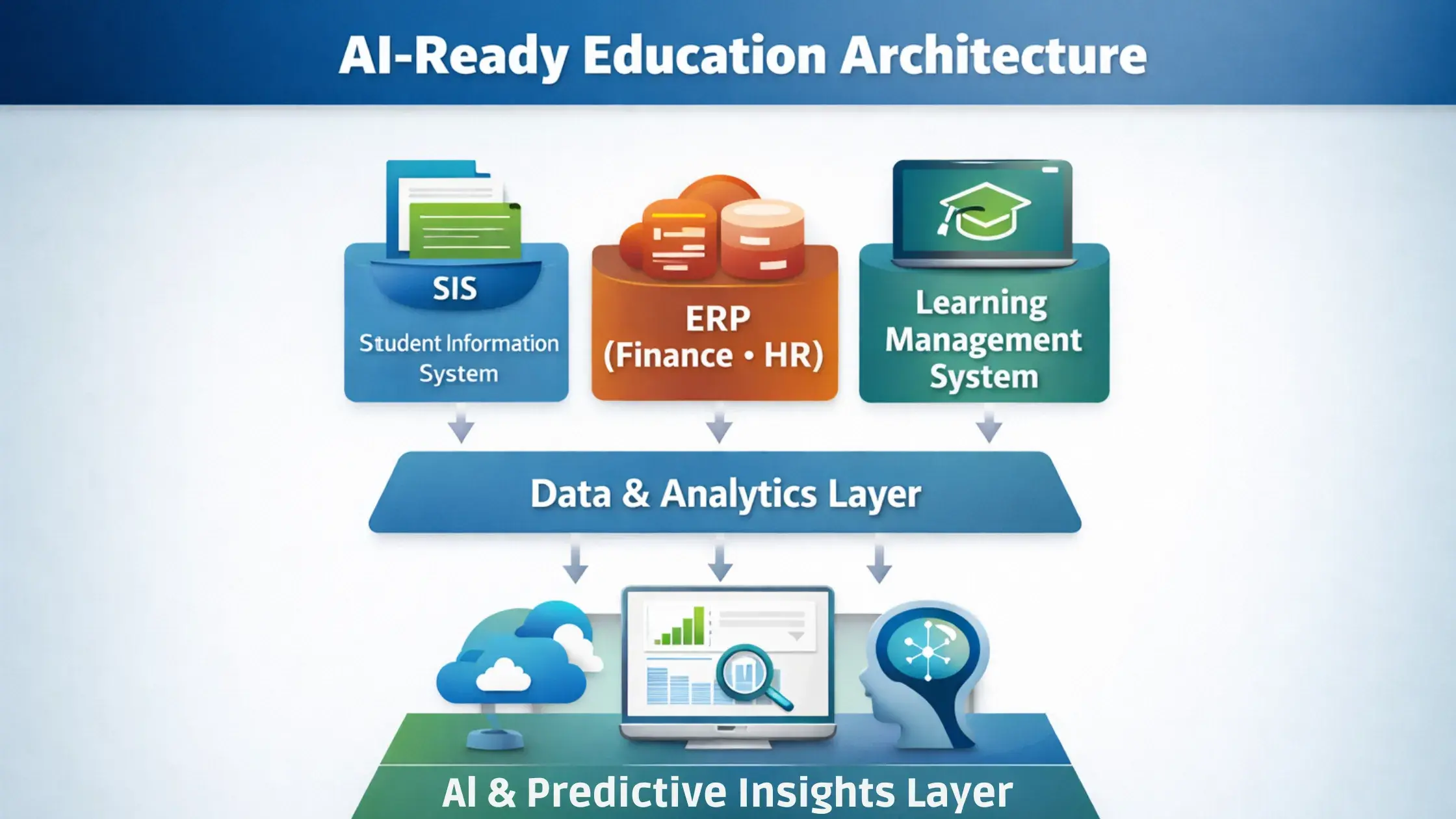
AI does not operate independently. It relies on the systems that store, manage, and govern institutional data.
When core platforms such as SIS, ERP, and LMS remain disconnected, AI initiatives struggle to scale. Insights remain limited, and decision-makers receive conflicting or incomplete information.
To support meaningful AI adoption, institutions need an AI-ready enterprise architecture.
This architecture enables:
- Secure and reliable data sharing across systems
- Consistent definitions of institutional metrics
- A foundation for analytics and predictive insights
Unified systems allow AI to reflect the institution’s whole operational reality rather than isolated snapshots.
The Foundation: Why Enterprise Architecture Enables
Responsible AI
Integrated Data Systems
Integrated data systems allow institutions to connect academic, financial, operational, and student data into a cohesive framework. This integration enables AI models to generate insights that align with institutional goals and priorities.
Without integration, AI outputs remain fragmented and complex to trust.
Role of ERP, Analytics, and Cloud Platforms
Modern education ERP systems play a critical role in enabling AI adoption. They provide standardized processes and reliable data structures for finance, HR, and planning.
When ERP systems are integrated with analytics platforms and cloud infrastructure, institutions gain the flexibility and scalability required for AI initiatives.
This combination supports data-driven decision-making across leadership, administration, and academic teams.
Governance as a Prerequisite for Scalable AI
AI governance in education ensures that AI initiatives align with ethical standards, regulatory requirements, and institutional policies.
Governance frameworks define:
- How data is collected, stored, and used
- Who can access AI insights
- How AI models are monitored and evaluated
Rather than limiting innovation, governance enables AI to scale responsibly and sustainably.
How Everite Supports AI-Ready Education Institutions
AI success depends on foundations, not tools.
At Everite Solutions, the focus is on enabling institutions to build the enterprise capabilities required for responsible AI adoption. Everite does not position AI as a standalone solution. Instead, it supports the systems, architecture, and governance that allow AI to deliver long-term value.
ERP Modernization for Education
Everite helps institutions modernize education ERP systems to support:
- Financial transparency and planning
- Workforce and faculty management
- Scalable, AI-compatible operations
Modern ERP environments ensure that AI insights are grounded in trusted enterprise data.
Governed Data and Analytics Architecture
AI depends on data quality and trust.
Everite designs governed data and analytics architectures that:
- Reduce data silos
- Improve consistency and accuracy
- Enable institution-wide reporting and forecasting
This approach strengthens data governance in education while enabling advanced analytics.
Cloud and Security Foundations
Secure, scalable infrastructure is essential for AI adoption.
Everite supports cloud and security foundations that help institutions maintain:
- Data privacy and regulatory compliance
- Resilient infrastructure for AI workloads
- Secure access across departments
Decision Support Analytics for Leaders and Educators
AI adds value when insights help with decision-making. Everite provides decision-support analytics that help leaders and educators with:
- Early signs of enrollment and retention issues
- Forecasts about finances and operations
- Actionable insights that match institutional goals
These capabilities enhance decision-making while preserving human judgment.
AI as a Partner to Human Decision-Making
AI is most effective when it complements human expertise.
Rather than replacing educators or administrators, AI enhances their decision-making by identifying patterns, predicting risks, and providing early signals.
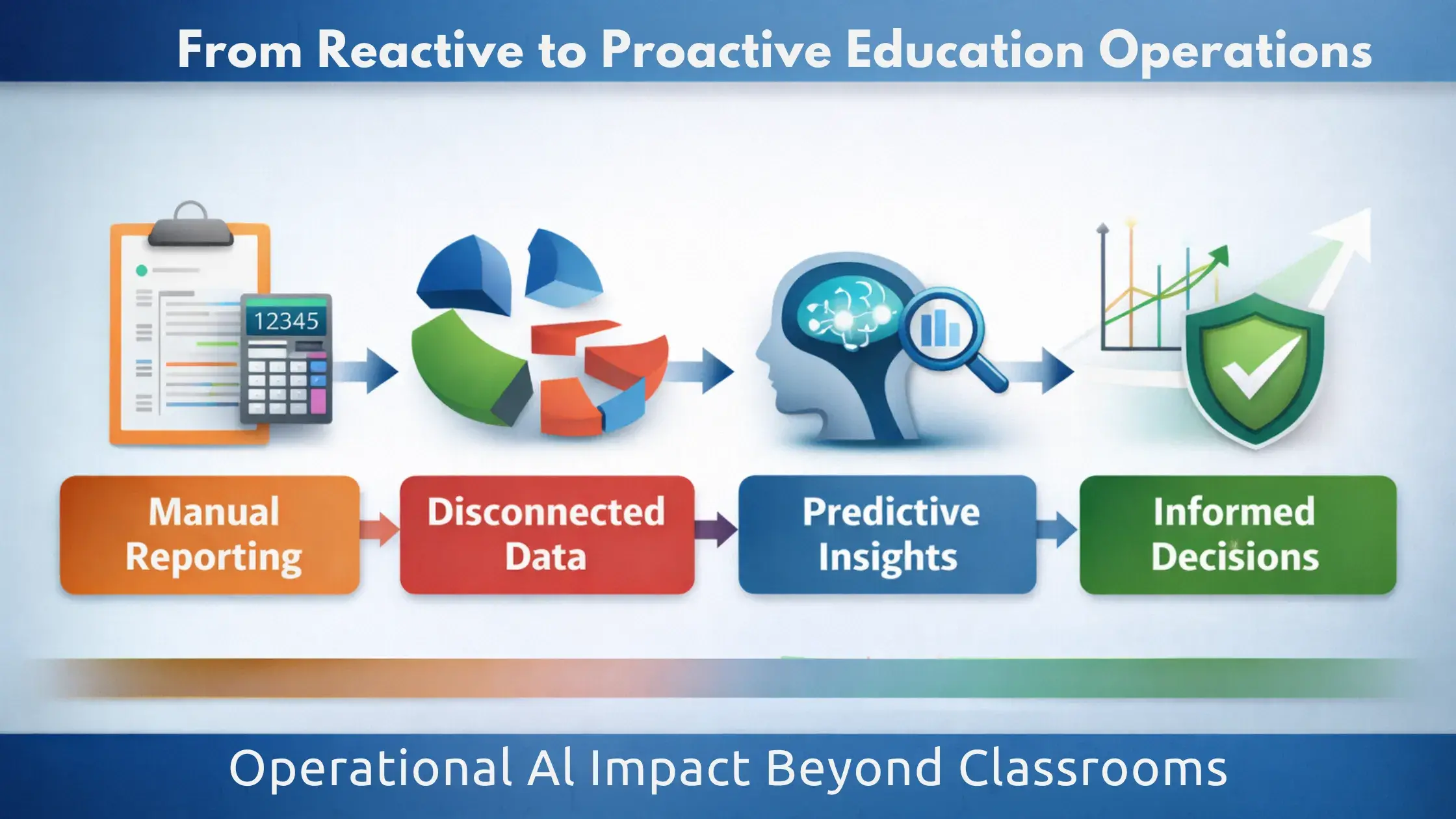
From Reactive to Proactive Institutions
Without AI, institutions often respond to challenges after they occur. With AI-supported insights, institutions can anticipate issues and act earlier.
This shift from reactive to proactive operations improves outcomes across learning, administration, and long-term planning.
FAQ
1. What is AI adoption in education?
AI adoption in education refers to integrating artificial intelligence across academic, administrative, and operational systems to improve decision-making, efficiency, and institutional outcomes—not just classroom learning.
2. Why does AI strategy matter more than speed in education?
Without a clear strategy, rapid AI adoption can create fragmented tools, data silos, and governance risks. A strategic approach ensures AI aligns with institutional goals and delivers long-term value.
3. How does AI governance support responsible adoption in education?
AI governance establishes policies for data privacy, security, ethics, and compliance. It ensures AI systems operate transparently, responsibly, and consistently across the institution.
4. What role do education ERP systems play in AI readiness?
Education ERP systems provide centralized, reliable data for finance, HR, and operations. When integrated with analytics, they form a critical foundation for scalable and trustworthy AI insights.
5. How is AI used beyond classrooms in higher education operations?
AI supports enrollment forecasting, financial planning, workforce optimization, and student lifecycle management—helping institutions move from reactive decision-making to proactive, data-driven operations.
Conclusion:
AI adoption in education is accelerating. But the impact of AI depends on how institutions approach it.
Speed alone does not guarantee success. Institutions that invest in enterprise architecture, integrated systems, and AI governance are better positioned to realize long-term value.
When supported by strong foundations, AI becomes a sustainable capability rather than a short-term experiment or institutional risk.
The future of digital transformation in education belongs to institutions that treat AI as part of a broader enterprise strategy—one built on structure, alignment, and responsible governance.
👉 Looking to adopt AI responsibly across your education institution?
Build the proper enterprise foundation first.
Follow Everite Solutions for insights on AI-ready education systems, enterprise architecture, and responsible digital transformation.