

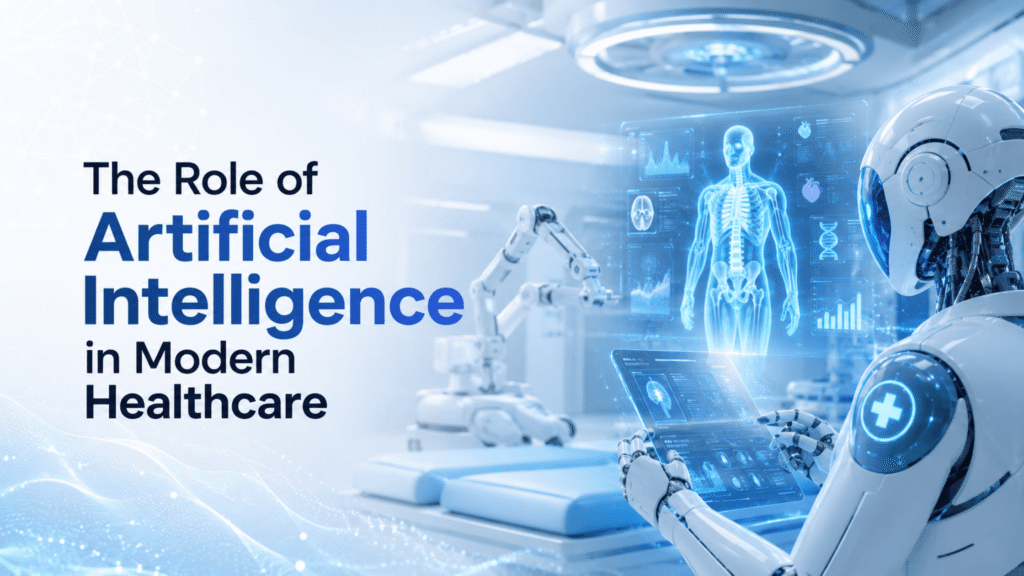
Modern Healthcare
AI in Healthcare is transforming modern medicine by improving diagnostics, patient care, treatment planning, and hospital operations. Healthcare organizations worldwide are using artificial intelligence to deliver faster, more accurate, and efficient medical services.
Artificial intelligence in healthcare represents one of the most promising technological advances in modern medicine. Unlike generic AI applications, healthcare AI must navigate complex regulatory environments, maintain patient privacy, and ultimately prove it improves clinical outcomes. The stakes are real. The potential is enormous.
At EVERITE Solutions, we’ve worked with healthcare organizations implementing AI systems that transform diagnosis, treatment planning, and patient management. This guide explores how AI is reshaping healthcare today and what it means for medical professionals and patients alike.
🏥 The Healthcare AI Reality
AI algorithms now match or exceed human radiologists in detecting certain cancers. Machine learning models predict patient deterioration hours before clinical signs appear. Natural language processing extracts critical information from unstructured medical records. These aren’t future possibilities—they’re happening today in leading healthcare organizations worldwide.
What is Healthcare Artificial Intelligence?
Healthcare AI applies machine learning, deep learning, and natural language processing to clinical and operational healthcare challenges. But defining it technically misses the human impact. Healthcare AI augments physician expertise, reduces diagnostic errors, and enables earlier interventions.
The difference between AI in healthcare and other industries is critical: healthcare AI must be explainable. A doctor needs to understand why an algorithm recommends a specific treatment. Patient data requires absolute protection. Regulatory compliance is non-negotiable. Top technology trends transforming healthcare recognize these constraints while delivering measurable clinical value.
Healthcare AI operates in three primary domains: diagnostics (identifying diseases), therapeutics (determining treatment), and operations (improving healthcare delivery). Each requires different approaches, different data, and different validation methods.
AI Applications Transforming Healthcare Today
1. Diagnostic Imaging and Radiology
This is where AI has achieved the most visible success. Radiology AI systems analyze medical images—X-rays, CT scans, MRIs—to detect abnormalities. Deep learning models trained on millions of images identify suspicious patterns invisible to the human eye.
Real-world impact: AI algorithms now detect breast cancer in mammograms with accuracy matching or exceeding radiologists. These systems don’t replace radiologists; they augment them. Radiologists review AI flagged images more carefully. Subtle findings receive proper attention. Reading speed increases without sacrificing accuracy.
2. Predictive Analytics and Early Intervention
Predictive AI models analyze patient data—vital signs, lab results, medication history, medical records—to forecast who will deteriorate. Machine learning identifies patterns in patient data that indicate impending sepsis, heart failure, or other crises.
A patient admitted with symptoms that seem stable. But machine learning analyzing their data predicts deterioration in the next four hours. Doctors intervene proactively. The patient receives aggressive treatment before crisis hits. This approach transforms reactive medicine into predictive medicine.
3. Natural Language Processing in Clinical Records
NLP systems extract meaningful information from unstructured clinical notes. Doctors write comprehensive notes describing patient encounters. Traditional systems couldn’t automatically extract key information. NLP changes that. Systems now identify medication allergies, relevant symptoms, and clinical findings automatically.
The impact extends beyond information extraction. NLP flags potential drug interactions. It identifies documentation gaps. It ensures critical patient information reaches the right clinician at the right time.
4. Personalized Treatment Planning
Machine learning models analyze patient genomics, medical history, and treatment response data to recommend personalized therapies. Cancer treatment exemplifies this: AI systems analyze tumor genetics and patient characteristics to predict which chemotherapy will work best.
This prevents patients from enduring ineffective treatments. It accelerates time to effective therapy. It embodies precision medicine—the right treatment for the right patient at the right time.
92%
Diagnostic Accuracy in AI-Assisted Radiology
4 Hours
Earlier Deterioration Detection
40%
Reduction in Administrative Burden
5. Drug Discovery and Development
AI accelerates the traditionally slow drug development process. Machine learning identifies promising drug candidates by analyzing molecular data. AI models predict how compounds will behave in human biology. Development timelines compress from years to months.
This matters enormously for rare diseases where traditional drug development is economically unviable. AI makes these developments possible.
Ready to Transform Your Healthcare Organization with AI?
EVERITE Solutions helps healthcare organizations implement AI systems that improve outcomes, enhance efficiency, and maintain compliance. From strategy to implementation.
Schedule Your Healthcare AI Consultation Explore Healthcare Technology Trends
Healthcare AI Benefits: Beyond Hype
Improved Patient Outcomes
Earlier diagnosis. More accurate treatment selection. Fewer complications. These translate directly to better health for patients. Clinical trials demonstrate AI-assisted care produces measurably better outcomes.
Reduced Healthcare Costs
AI identifies inefficient processes. It prevents unnecessary procedures. It reduces hospital readmissions through earlier intervention. Organizations implementing comprehensive AI strategies report 15-25% reductions in operational costs.
Physician Productivity and Satisfaction
Contrary to fears about AI replacing doctors, AI increases physician productivity. Administrative burden decreases. Time with patients increases. Doctors make better decisions with AI support. This improves job satisfaction and reduces burnout.
Addressing Healthcare Disparities
Healthcare inequality persists across demographics. Well-trained AI models, built on diverse datasets, can democratize expertise. A patient in a rural clinic accessing AI diagnostic support matches a patient in an academic medical center. This has profound implications for health equity.
✓ Real Healthcare Improvements from AI Implementation
Diagnostic Accuracy: AI detects conditions earlier when treatment is more effective. Treatment Efficiency: Personalized AI recommendations mean fewer failed treatments. Operational Excellence: AI optimization reduces wait times and improves resource allocation. Staff Satisfaction: Doctors spend less time on administration and more time with patients.
Challenges in Healthcare AI Implementation
Data Quality and Availability
AI models require massive amounts of quality data. Healthcare data is fragmented across different systems. Data privacy regulations limit data sharing. Organizations must solve data integration challenges before AI can be effective.
Regulatory Compliance
Healthcare AI must meet stringent FDA requirements. Clinical validation is mandatory. Documentation must be comprehensive. Compliance timelines extend implementation timelines significantly.
Bias and Fairness
AI models trained on biased data perpetuate bias. If training data underrepresents certain demographics, AI models perform poorly for those groups. Healthcare technology trends increasingly emphasize identifying and eliminating algorithmic bias.
Physician Adoption
Doctors rightfully maintain skepticism about AI systems. Trust must be earned through transparent algorithms, strong clinical validation, and demonstrated improvements. Change management and training are essential.
The Future of Healthcare AI
The trajectory is clear. AI integration in healthcare will accelerate. Wearable devices will generate continuous patient data. Predictive models will become increasingly sophisticated. Genomic medicine will become routine. Organizations that embrace AI thoughtfully will lead. Those that wait will struggle to compete.
Frequently Asked Questions
Will AI replace doctors?
No. AI augments physician expertise rather than replacing it. Doctors will increasingly work alongside AI systems. Physicians who understand how to effectively use AI will thrive. The relationship is symbiotic, not competitive.
How is patient data protected in AI healthcare systems?
Patient data is protected using encryption, secure cloud systems, access controls, and HIPAA-compliant security standards. AI systems also use anonymized data to maintain privacy.
How accurate is healthcare AI?
Healthcare AI can achieve very high accuracy in diagnostics and predictions when trained on quality medical data. Doctors still verify AI recommendations before treatment decisions.
How long before AI transforms healthcare?
AI is already transforming healthcare today. Major advancements will become widespread over the next 5–10 years.
What should healthcare organizations do now?
Organizations should start with pilot AI projects, improve data infrastructure, ensure compliance, and train healthcare staff for AI adoption.
How does AI improve patient outcomes?
AI helps detect diseases earlier, supports faster diagnosis, personalizes treatments, and reduces medical errors for better patient care.
Is healthcare AI expensive?
Initial setup can be costly, but AI reduces long-term operational expenses through automation, efficiency, and improved healthcare outcomes.
Healthcare AI Implementation Checklist
✓ Essential Steps for Healthcare AI Adoption
- Assess organizational readiness and identify high-impact use cases
- Evaluate regulatory requirements (FDA, HIPAA, local regulations)
- Establish data governance and integration infrastructure
- Identify qualified vendors and solution providers
- Conduct pilot projects in controlled environments
- Develop physician training and change management programs
- Implement patient privacy and data security measures
- Establish clinical validation and outcome tracking
- Create feedback loops for continuous improvement
- Build internal AI expertise and knowledge
- Plan for system integration and interoperability
- Document clinical and operational outcomes
- Scale successful pilots to broader implementation
Transform Your Healthcare Organization Today
EVERITE Solutions specializes in healthcare AI strategy and implementation. From initial assessment through full deployment, we help healthcare organizations leverage AI to improve outcomes, enhance efficiency, and deliver better patient care.
Begin Your Healthcare AI Journey →
About EVERITE Solutions
EVERITE Solutions helps healthcare organizations implement artificial intelligence systems that improve patient outcomes and operational efficiency. We specialize in understanding healthcare-specific challenges and delivering AI solutions that work within regulatory constraints while delivering measurable value. From technology trends transforming healthcare to comprehensive healthcare technology strategies, we cover every aspect of your digital transformation. Explore our healthcare solutions or contact our team today.