

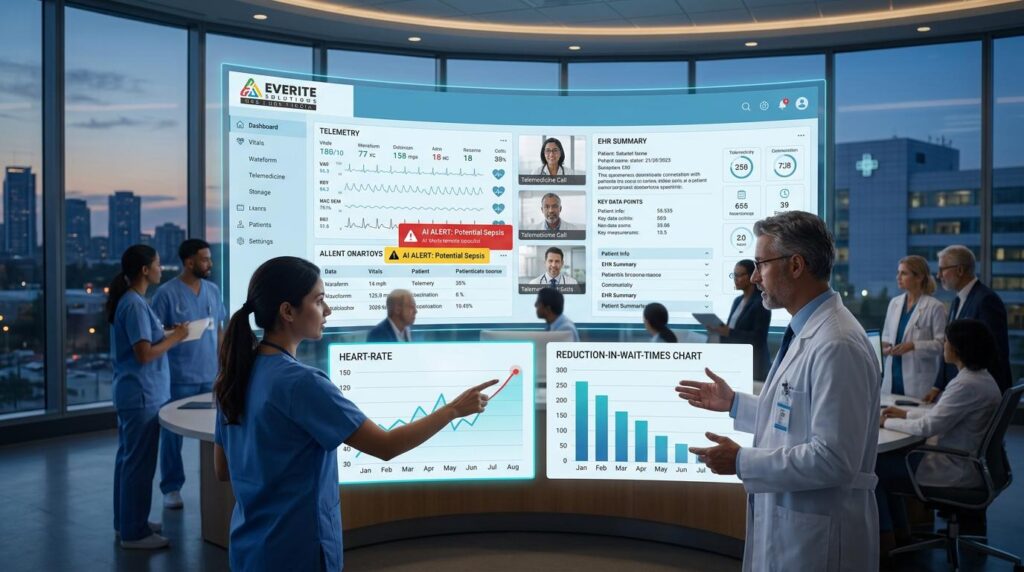
Healthcare is broken. Not completely, but enough that patients are frustrated waiting weeks for appointments, clinicians are burned out from administrative chaos, and hospital leaders are watching costs spiral while outcomes stagnate. Then you walk into a hospital using modern technology, and you see something different: patients booking appointments in seconds, doctors spending time with patients instead of paperwork, and teams making faster, smarter decisions.
The difference? Healthcare technology trends aren’t buzzwords anymore, they’re practical tools solving real problems right now.
Why Your Organization Can’t Ignore These Healthcare Technology Trends
Here’s what’s happening in hospitals right now:
A radiologist at a busy hospital reviews hundreds of images daily. She’s exhausted, running behind, and knows she’s missing things because of fatigue. Then AI-powered diagnostic tools step in—not to replace her, but to catch what’s easy to miss. She reviews the AI’s flags, catches the cancer early, and goes home less stressed. One patient gets treated before their cancer spreads.
A diabetic patient in rural Montana drives 3 hours for appointments. Then, remote patient monitoring arrives. Now he video calls his endocrinologist weekly, checks his glucose at home, and his numbers improve. He also stops missing work.
A heart failure patient receives a wearable health technology device—an ECG patch that monitors her heart rhythm continuously. When her rhythm changes, the device alerts her doctor immediately. She gets a medication adjustment before ending up in the emergency room. One prevented hospitalization costs $15,000—more than the wearable investment for an entire year.
These aren’t futuristic scenarios. They’re happening today at forward-thinking hospitals implementing healthcare technology trends strategically.
The organizations leading in patient outcomes, clinician satisfaction, and financial performance aren’t the ones waiting to see if these healthcare technology trends matter. They’re the ones implementing them now.

1. AI-Powered Diagnostic Tools: Making Clinicians Superhuman
AI-powered diagnostic tools in healthcare aren’t about robots taking over. They’re about giving clinicians superhuman capabilities when they need it most.
The reality: These tools analyze imaging studies 24/7, spot patterns humans miss, and flag urgent cases. One hospital reduced diagnostic errors by 15% and cut report turnaround time from 48 hours to 18 hours. Radiologists reported less burnout. Patients got diagnosed faster.
But the real magic happens in operational efficiency. AI-powered diagnostic tools optimize scheduling, predict admission surges, and manage bed allocation—freeing hospital staff to focus on actual patient care instead of logistics.
The human element matters: The hospitals succeeding with AI-powered diagnostic tools aren’t replacing clinicians. They’re using AI to handle the tedious, repetitive work (image screening, data analysis) so doctors can focus on complex decisions requiring human judgment. That’s when you see real improvement.
A 2023 Accenture study projected that AI-powered diagnostic tools could save the US healthcare system $150 billion by 2026. But the real payoff? Healthcare workers who feel like healers again, not data entry clerks.
2. Telemedicine: Breaking Geographic Barriers
A patient in rural Wyoming used to drive 6 hours to see a cardiologist. Now she video calls him from home, avoids taking days off work, and gets better care because continuous virtual monitoring catches problems earlier.
This is why telemedicine platforms transform the delivery of healthcare. It’s not just convenience—it’s equity. Rural patients access specialists. Working parents skip less work. Chronic disease management becomes a continuous process rather than an episodic one.
The obstacles are real, though. Technology literacy gaps, inconsistent insurance reimbursement, and legitimate privacy concerns make implementation messy. Organizations succeeding at telemedicine invest in user-friendly interfaces, patient support during first use, and ironclad security protocols.
The payoff? Better medication adherence (patients actually show up for virtual visits), earlier interventions (continuous monitoring catches problems before crises), and cost savings that make CFOs happy (virtual visit preventing one hospitalization pays for 50 telemedicine consultations).
3. Wearable Health Technology and Remote Patient Monitoring: Prevention Over Crisis
Stop me if this sounds familiar: A heart failure patient feels worse, waits days for an appointment, by then they’re in crisis, and end up hospitalized. That costs $15,000+. A remote patient monitoring solution catches early warning signs through wearable health technology, triggers a phone call from the care team, a medication adjustment happens, and the patient stays home.
This is why clinical-grade wearable health technology matters. ECG patches detecting irregular rhythms. Continuous glucose monitors preventing dangerous blood sugar swings. Smart inhalers track medication adherence. Implantable devices transmitting daily status directly to cardiologists.
Remote patient monitoring through integrated wearable health technology reduces hospital readmissions by 30-50% for high-risk patients. More importantly, patients feel safer. They’re not wondering if they should go to the ER; their care team knows exactly what’s happening.
The implementation challenge? Data from 20 different devices creates overwhelm, not insight. You need platforms consolidating all that wearable health technology data into your existing EHR system, alerting clinicians only when action is needed, and giving patients visibility into their own health.
4. Electronic Health Records Integration: Finally Making Doctors’ Lives Easier
Modern Electronic Health Records were supposed to be revolutionary. Instead, many clinicians spend more time clicking boxes than talking to patients. That’s changing.
New Electronic Health Records systems feature clinical decision support (AI checking drug interactions and flagging inappropriate combinations), patient portals that patients actually use, and analytics dashboards showing what’s really happening in your hospital—not what the billing department wants you to see.
But here’s the game-changer:Healthcare data integration across different Electronic Health Records systems. You have System A from one vendor, your specialists use System B, and your insurance works with System C. Information siloes develop. Critical patient history gets missed. New interoperability standards like FHIR finally let different systems talk, so specialists see complete medical histories instantly instead of requesting faxed records.
Security matters too. HIPAA compliance is table stakes. Advanced encryption, blockchain experimentation, and regular security audits protect patient data while enabling broader access when appropriate.
5. Personalized Medicine Using Genomics
Cancer treatment is changing. Instead of chemotherapy harming healthy cells alongside cancer cells, doctors now identify specific mutations driving individual tumors, then deploy targeted therapies attacking only those mutations.
A patient receives genetic testing. Bioinformatics specialists identify which mutations their cancer has. AI analyzes which medications work best for their specific mutations. The doctor prescribes treatment tailored to individual biology—not a one-size-fits-all approach.
Result? Higher response rates, fewer side effects, better survival.
This extends beyond cancer. Pharmacogenomics shows how quickly your body metabolizes medications eliminating ineffective dosing. Preventive genetics identify predisposition to breast cancer or heart disease early, enabling screening protocols to prevent disease entirely.
Patients receiving personalized medicine report feeling heard (“This treatment is designed specifically for me”), hopeful (targeted approaches versus shotgun strategies), and engaged (they understand why they’re taking specific drugs).
6. IoMT and Connected Devices: Continuous Insight
Smart inhalers track when asthma patients use medication and identify environmental triggers. Connected blood pressure monitors sync readings directly to your doctor’s office. Implantable cardiac devices transmit status daily, preventing emergencies.
This Internet of Medical Things shifts healthcare from monthly office visits showing incomplete pictures to continuous monitoring showing real behavior. A hypertensive patient’s home readings reveal patterns; office readings don’t. A diabetes patient sees real-time glucose trends instead of guessing.
IoMT integration with Electronic Health Records systems and clinical workflows enables clinicians to see complete data without checking separate dashboards. When devices automatically alert care teams to dangerous trends, problems get caught early.

7. Robotics and Automation: Precision Where It Matters
Surgical robots aren’t replacing surgeons—they’re giving surgeons superhuman precision. The da Vinci system enables complex procedures through tiny openings, reducing trauma, speeding recovery, and achieving better outcomes.
Automation pharmacy systems dispense medications with near-zero error rates (versus pharmacist error rates of 0.5%). Robotic systems transport supplies and samples 24/7. Lab analyzers process hundreds of samples daily.
The outcome? Better jobs. Surgeons focus on surgical judgment rather than repetitive movements. Nurses interact with patients instead of chasing supplies. Pharmacists counsel patients instead of counting pills. Automation handles boring, error-prone tasks; humans handle complex decisions.
8. Patient Engagement Platforms: Communication That Works
A patient self-schedules an appointment at midnight, gets reminders reducing no-shows by 40%, and can message their doctor with non-urgent questions (reducing unnecessary ER visits). When lab results come back, they see results when their doctor does, with educational explanations they actually understand.
This sounds basic. But it’s revolutionary for patient engagement and adherence. Studies show appointment reminders reduce no-shows 30-40%. Medication reminders improve compliance by 20-30%. Combined engagement strategies improve outcomes more than any single intervention.
The best platforms track adherence, analyze which interventions actually work, and measure clinical outcomes—not just engagement metrics.
Taking the First Step: Implementing Healthcare Technology Trends
These healthcare technology trends aren’t something you implement later. They’re tools forward-thinking organizations are deploying now. The hospitals winning in patient outcomes, clinician satisfaction, and financial performance aren’t the ones waiting to see if these healthcare technology trends matter. They’re the ones moving.
But where do you start? Start with your biggest pain point. High readmission rates? Implement remote patient monitoring and wearable health technology. Diagnostic delays? Consider AI-powered diagnostic tools. Clinician burnout? Workflow automation and better Electronic Health Records free clinicians from administrative burden.
Success comes from integration, not point solutions. Fifteen different vendors create fragmentation. Integrated platforms combining Electronic Health Records, remote monitoring, AI analytics, and patient engagement create coordinated care that works.
The Everite Difference: Leading Healthcare Technology Trends Implementation
Everite’s healthcare solutions combine these healthcare technology trends into integrated platforms. Instead of managing 15 vendors and cobbling together data, you get one system handling diagnostics, monitoring, engagement, and analytics—all working together seamlessly.
One regional hospital implementing Everite’s remote patient monitoring platform, combined with AI-powered diagnostic tools for risk prediction, reduced heart failure readmissions from 25% to 18%—saving $2.1 million annually while improving patient satisfaction by 22 points.
This isn’t theoretical. This is what happens when healthcare technology trends are implemented strategically with the right partner.

Understanding Why These Healthcare Technology Trends Matter
Healthcare technology trends matter because they address the fundamental challenges healthcare organizations face: clinician burnout, patient dissatisfaction, rising costs, and declining outcomes. These aren’t nice-to-have features. They’re essential tools for survival in modern healthcare.
The hospitals that understand healthcare technology trends and implement them strategically aren’t just improving metrics. They’re transforming how care gets delivered. They’re freeing clinicians to do what they went to medical school for. They’re giving patients the care and attention they deserve. They’re building sustainable, profitable operations that can weather future challenges.
Ready to Transform Your Healthcare Organization?
Healthcare technology trends are reshaping how care is delivered. But implementation is complex, and choosing the wrong partner wastes time and money.
Schedule a 30-minute consultation with our healthcare technology experts to discuss:
- Which healthcare technology trends solve your specific challenges
- How hospitals similar to yours successfully implemented healthcare technology trends solutions
- Realistic timelines and ROI for your organization
- First steps to get started within 30 days
No pitch. No pressure. Just practical advice from people who’ve helped dozens of hospitals improve outcomes, reduce costs, and restore clinician satisfaction.
Get Your Free Healthcare Technology Assessment — Answer 10 quick questions about your current technology and patient outcomes, and receive personalized recommendations based on your specific situation.

Explore How to Implement Healthcare Technology Trends Successfully
- How AI-Powered Healthcare Technology is Elevating At-Home Care — See how remote patient monitoring and AI-powered diagnostic tools transform chronic disease management
- Solutions for Integrating Healthcare Data — Learn how Electronic Health Records data integration unlocks personalized medicine and predictive analytics powered by AI-powered diagnostic tools
- Everite’s Healthcare Industry Solutions — Explore our complete healthcare technology trends services for hospitals of all sizes
Healthcare Technology Trends Are Essential Now
The question isn’t whether these healthcare technology trends matter. It’s whether you’ll implement them before competitors do, before patient expectations demand it, or after you’ve lost market share.
Organizations leading in healthcare right now aren’t waiting. They’re implementing healthcare technology trends strategically. They’re using AI-powered diagnostic tools to reduce errors. They’re deploying remote patient monitoring to prevent crises. They’re integrating Electronic Health Records systems to break down data silos. They’re investing in wearable health technology to engage patients in their own care.
The hospitals implementing healthcare technology trends today will be the ones thriving in 2026. The question is: Will yours be one of them?
The answer starts with understanding healthcare technology trends, recognizing your biggest pain points, and taking that first step toward transformation.
Contact our healthcare technology team today and see how we help organizations like yours lead with healthcare technology trends.
Key Takeaways: Healthcare Technology Trends Driving Modern Healthcare
- AI-powered diagnostic tools reduce diagnostic errors by 15% while cutting turnaround times
- Remote patient monitoring reduces hospital readmissions by 30-50%
- Wearable health technology keeps patients engaged and prevents crises
- Electronic Health Records integration breaks down information silos
- Healthcare technology trends aren’t optional—they’re competitive advantages
- Success requires integration, not point solutions
- The time to act on healthcare technology trends is now