


Somewhere between the vendor demo and the go-live date, something goes wrong. It doesn’t happen to every ERP project — but it happens to enough of them that the pattern is hard to ignore.
Sometimes it’s a budget that doubles. Sometimes it’s a system that technically works, but nobody actually uses it. Sometimes, it’s a go-live that keeps getting pushed back until leadership loses confidence in the entire effort.
Here’s what most post-mortems reveal: the failure wasn’t inevitable. It was the result of specific, identifiable mistakes — most of which were made in the first few weeks of the project.
Understanding those mistakes before you make them is one of the highest-value things you can do for your ERP implementation. This guide walks through all nine, with enough detail to actually change how you approach the work.
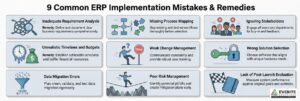
1. Inadequate Requirement Analysis and Planning
The single most expensive thing you can do in an ERP project is rush the planning phase. It feels like progress — you’re moving, you’re deciding, you’re building momentum. But every shortcut taken here generates compounding costs later.
Mistake #1: Skipping Business Process Mapping
Before a single configuration decision is made, you need an honest, ground-level picture of how your business actually operates. Not how the process manual says it works — how it really works, with the workarounds, exceptions, and informal rules that have accumulated over the years.
Business process mapping surfaces the gaps between your current reality and the ERP’s default workflows. Without it, you end up customizing mid-implementation frantically to make the system fit operations it was never configured to support.
Mistake #2: Ignoring Stakeholder Input
ERP systems touch nearly every department — finance, operations, sales, HR, and logistics. If the people who will live inside the system every day aren’t part of shaping it, you’ll hear about their problems at go-live instead of during planning. That’s a painful and expensive time to discover missing requirements.
Early stakeholder engagement doesn’t just surface better requirements. It builds the political will to see the project through, which matters more than most organizations realize.
Mistake #3: Setting Unrealistic Timelines and Budgets
Optimistic schedules are one of the most common causes of ERP failure. When the timeline is too tight, corners get cut — in testing, in training, in data validation. The project technically launches, but it launches broken.
Realistic planning means building in a buffer for the complexity you haven’t discovered yet, not just the complexity you can see. ERP projects consistently surface surprises. The ones that succeed are the ones that planned for that reality.
| Quick check: If your ERP timeline was built primarily around leadership’s preferred go-live date rather than a detailed bottom-up estimate, treat that as a risk flag worth addressing now. |

2. Poor Change Management and User Training
This is where otherwise well-planned ERP projects fall apart. The technology works fine. The data migrated cleanly. But three months after go-live, people are emailing spreadsheets to each other because the system feels foreign and frustrating.
Software doesn’t deliver ROI. People using software deliver ROI. Change management is what bridges that gap.
Mistake #4: Underestimating User Resistance
Resistance to new ERP systems is rarely irrational. Employees have built muscle memory around their current tools. They’ve developed workarounds that, from their perspective, work fine. Asking them to abandon all of that for an unfamiliar system — while keeping up with their normal workload — is a legitimate ask that deserves a real response.
The organizations that handle this well involve users early, explain the “why” honestly (including the pain the new system will cause before it gets easier), and create visible feedback channels. The ones that handle it poorly announce the change and expect enthusiasm.
Mistake #5: Insufficient Training Programs
Generic training that covers the system broadly but doesn’t address what each role specifically needs to do is nearly useless. A warehouse manager and a CFO interact with an ERP completely differently. Training that tries to serve both usually serves neither.
Effective training is role-specific, hands-on, and delivered close enough to go-live that it’s still fresh. It also doesn’t end at go-live — refresher sessions, short reference guides, and dedicated support channels in the weeks after launch make a measurable difference in sustained adoption.
Mistake #6: Abandoning Users After Go-Live
Go-live is not the finish line. It’s more like the first mile of a marathon — the part where you find out whether your preparation was actually adequate.
The weeks immediately after launch are when user frustration peaks, when edge cases surface that testing didn’t catch, and when the gap between training and reality becomes obvious. Organizations that have a dedicated support structure during this period recover quickly. Those who assume the project is done at go-live often spend the next year quietly firefighting.
3. Choosing the Wrong ERP Solution
Selecting an ERP platform is one of the most consequential decisions in the entire project. The wrong choice doesn’t just create inconvenience — it creates structural constraints that shape your options for years. Getting it right requires honest evaluation against your actual needs, not a vendor’s best demo scenario. This is where professional ERP consulting pays for itself many times over.
Mistake #7: Misalignment with Business Needs
ERP platforms vary enormously in how well they serve different industries, company sizes, and operational models. A system designed for discrete manufacturing doesn’t map cleanly onto a professional services firm. A platform built for enterprise-scale operations may be overkill — and overcomplicated — for a mid-market company.
The question to answer isn’t “which ERP is best?” It’s “which ERP is best for how we actually operate and where we plan to go?” Those are different questions, and confusing them is expensive.
Mistake #8: Overlooking Scalability and Flexibility
Your business today is not your business in five years. Acquisitions, new product lines, geographic expansion, regulatory changes — any of these can stress an ERP system that wasn’t chosen with future growth in mind.
Scalability is particularly important in cloud ERP selection. A system that works well at your current scale but requires expensive re-implementation as you grow is a hidden liability. Cloud ERP migration done well accounts for where you’re going, not just where you are.
Mistake #9: Neglecting Vendor Reputation and Support
The quality of vendor support becomes critically important at the worst possible times — during a go-live crisis, when a critical process breaks, when you need a customization that’s at the edge of the platform’s capabilities. Vendors who are responsive and expert during those moments are worth paying for.
Research vendor track records with companies similar to yours in size and industry. Talk to their existing customers directly, not just the references the vendor provides. The gap between a vendor’s sales experience and their support experience is often significant.
4. Data Migration Errors
Data is the foundation your ERP runs on. Every report, every decision, every automated workflow depends on data that is complete, accurate, and properly structured. Errors introduced during migration don’t stay contained — they propagate through the system in ways that are often difficult to trace and painful to fix.
Incomplete or Inaccurate Data Transfer
Partial migrations — where some records, some historical data, or some relationships between records are left behind — create gaps that show up as mysterious errors in reporting and operations. Every field migrated needs to be validated, not just the obvious ones.
Skipping Data Cleansing Before Migration
Legacy systems accumulate years of duplicates, inconsistencies, outdated records, and formatting variations. Migrating that data as-is doesn’t just bring your records across — it brings your data quality problems across, now embedded in a new system that’s harder to correct.
Data cleansing before migration is tedious and time-consuming. It is also non-negotiable if you want the new system to be trustworthy from day one.
Failing to Verify Data Integrity After Migration
Even a well-executed migration needs post-migration testing. Automated validation checks, manual spot-checks on critical record types, and reconciliation between source and destination systems all catch errors that weren’t visible before the move.
| The cost of data errors is not just operational — it’s political. When a CFO pulls a report and the numbers don’t match what finance knows to be true, trust in the system erodes immediately. Rebuilding that trust takes months. |
5. Inadequate Risk Management
Every ERP project carries risk. Technical risk, organizational risk, financial risk, vendor risk. The organizations that navigate these successfully aren’t the ones that avoid risk — they’re the ones that see it clearly and plan for it deliberately. A solid ERP risk management strategy isn’t a luxury. It’s what keeps a difficult project from becoming a failed one.
Ignoring Potential Project Risks
Risk identification is most valuable at the beginning of a project, when there’s still time to mitigate. Teams that skip this step — often because it feels too abstract — end up discovering risks as active problems rather than potential ones.
No Formal Risk Mitigation Plan
Identifying risks without deciding in advance how to respond to them is only half the work. A risk mitigation plan defines specific triggers, ownership, and response protocols for the risks most likely to materialize. When something goes wrong mid-project, that plan is the difference between a calm, coordinated response and a reactive scramble.
Not Leveraging ERP Risk Management Best Practices
Industry frameworks for ERP risk management exist because the same risks appear again and again across implementations. Organizations that treat their project as sui generis — too unique to benefit from established practices — typically make the same mistakes that those frameworks were designed to prevent. Minimizing risk in ERP implementation is a learnable, repeatable discipline.

6. Insufficient Customization and Integration
The ERP customization question is one of the most debated in implementation circles, and for good reason. Too little customization leaves real operational needs unmet. Too much creates a system that’s expensive to maintain, difficult to upgrade, and prone to breaking in unexpected ways.
Over-Customizing the System
Every customization is a future liability. Customized code that works fine with version 12 of the ERP may require significant rework when version 13 is released. Organizations that heavily customize their ERP often find themselves stuck on older versions because upgrading is too painful — which means they gradually fall behind on features and security updates.
The discipline of accepting standard functionality wherever possible — even when it’s not quite what you wanted — pays dividends for years after go-live.
Poor Integration with Existing Systems
ERP systems don’t operate in isolation. They need to exchange data with CRM platforms, warehouse management systems, e-commerce tools, payroll providers, and often dozens of other applications. When those integrations are poorly designed, data silos form, manual reconciliation work multiplies, and the ERP’s promised single-source-of-truth never actually materializes.
Failing to Plan for Future Integration Needs
Integration architecture built only for today’s systems creates painful technical debt when new systems are added. A scalable integration strategy — one that uses well-documented APIs and standard middleware rather than point-to-point custom connections — makes future additions dramatically easier.
7. Lack of Executive Sponsorship and Communication
ERP projects cross organizational boundaries in ways that almost no other initiative does. They require decisions that affect multiple departments, force trade-offs between competing interests, and demand sustained attention from people who have many other priorities. Without strong, visible executive sponsorship, those decisions get deferred, those trade-offs get avoided, and the project loses momentum at precisely the moments when it most needs it.
Weak Leadership Involvement
Executive sponsors who check in quarterly and sign off on budgets but aren’t visibly engaged with the project send a signal — even if they don’t intend to — that this initiative isn’t a top priority. That signal is picked up at every level of the organization and shapes how much effort people invest in making it work.
Poor Communication Across Departments
When different teams have different understandings of what the ERP project is trying to accomplish, what’s changing, and what’s expected of them, misalignment compounds throughout implementation. Regular, transparent communication — not just status updates, but genuine explanation of decisions and their rationale — keeps the organization moving in the same direction.
Misalignment Between ERP Goals and Business Strategy
An ERP implementation that isn’t explicitly tied to specific business outcomes is vulnerable. When the project hits rough patches — and it will — the question “why are we doing this?” needs a clear, compelling answer. Without one, it’s difficult to maintain the commitment required to push through the hard parts.
8. Ignoring Post-Implementation Evaluation
Go-live is not success. It’s the beginning of the evaluation period — the phase where you find out how well the implementation actually performed against the goals it was supposed to serve.
Not Measuring ERP ROI Effectively
Organizations that don’t define clear metrics before go-live have no baseline against which to measure results. Knowing that the ERP is “working” is different from knowing that it’s delivering the efficiency gains, error reductions, and decision-support improvements it was supposed to provide. If you’re not sure how to structure this, start with how to calculate ERP implementation ROI — the methodology matters as much as the measurement.
Overlooking User Feedback and System Performance
Users who are struggling with the system will find workarounds before they file formal complaints. Proactive feedback collection — short surveys, periodic check-ins, open channels for reporting issues — surfaces problems while they’re still small enough to fix without major disruption.
Delaying System Updates
ERP vendors release updates that contain performance improvements, security patches, and new functionality. Organizations that fall behind on updates accumulate technical debt and security exposure while simultaneously missing out on improvements that could deliver real operational value.
9. Underestimating the Value of Professional ERP Consulting
There’s a version of ERP implementation where an internal team handles everything — vendor selection, configuration, training, data migration, and change management. In theory, it saves consulting fees. In practice, it usually costs significantly more, in both time and money, than bringing in experienced ERP consultants from the start.
Skipping Expert Guidance
Consultants who have run dozens of ERP implementations bring pattern recognition that no amount of internal preparation can replicate. They’ve seen which vendor promises don’t hold up. They know which configurations look good in demos and cause problems in production. They’ve navigated the political dynamics of multi-department projects before. That experience is genuinely hard to substitute.
Missing Out on Best Practices and Industry Insights
The difference between an organization’s first ERP implementation and its consultant’s fiftieth is a significant knowledge gap. Experienced consultants bring proven methodologies, implementation frameworks, and industry-specific insights that compress learning curves and prevent the most common failure modes. Explore how Everite’s ERP implementation services translate this expertise into measurable outcomes for clients.
From the Field: A Manufacturing Case Study
Abstract warnings are easier to dismiss than concrete examples. So here’s what these mistakes — and their corrections — looked like in practice.
The Situation
A mid-sized manufacturing company came into their ERP project with real ambitions: unify fragmented data, eliminate reporting delays, and reduce the operational friction that was costing them speed and money. What they underestimated was the complexity of the change they were attempting.
What Went Wrong — and When It Was Caught
Early in the project, stakeholder engagement was treated as a box-checking exercise rather than a genuine information-gathering process. Key operational teams weren’t deeply involved in requirements definition. Data cleansing was deferred because it felt like a distraction from the “real” implementation work.
The result was predictable in retrospect: resistance from frontline users who didn’t feel heard, and data quality problems that surfaced during UAT rather than before migration.
When they brought in Everite Solutions, the approach shifted. Requirements were re-examined with broader stakeholder involvement. A proper data cleansing process was executed before migration. Training was rebuilt around specific user roles rather than the generic materials the vendor had provided.
The Outcome
| The implementation finished on time and within the revised budget.
User adoption exceeded 90% within the first quarter — a direct result of the role-specific training and the change management work that had been absent in the initial approach. Within six months, the company measured a 25% improvement in operational efficiency, with inventory errors and order processing delays both falling substantially. |
The lesson isn’t that the company was negligent. It’s that ERP implementation is genuinely hard, and the mistakes they made are the same ones that smart, well-intentioned teams make regularly. The difference was catching them early enough to correct course.
Frequently Asked Questions
What are the most common ERP implementation mistakes?
The mistakes that appear most consistently are: inadequate planning and requirements analysis, weak change management and training, choosing an ERP that doesn’t fit the business, data migration errors, and insufficient executive sponsorship. Most ERP failures involve several of these simultaneously — they tend to compound each other.
How can I keep my ERP project on budget and on schedule?
Realistic timeline and budget development — built from detailed bottom-up estimates rather than top-down preferences — is the foundation. Beyond that: experienced project governance, weekly risk reviews, strong executive sponsorship, and a consulting partner who has navigated comparable projects before. Cutting corners on any of these trades short-term convenience at long-term cost.
Why does user training matter so much for ERP ROI?
Because the return on an ERP investment is entirely dependent on people using the system effectively. A system that processes transactions incorrectly because users weren’t trained properly doesn’t reduce costs — it adds a new category of error on top of the old ones. Training is not a soft benefit. It’s the mechanism through which ROI is realized or lost.
How does professional ERP consulting reduce implementation risk?
Consultants bring two things that internal teams typically lack: implementation experience across many projects, and independence from internal politics. The experience helps avoid the most common failure modes. The independence helps surface and resolve issues that might otherwise go unaddressed for too long. Everite’s ERP consulting approach applies to every engagement.
What role does cloud ERP play in avoiding implementation mistakes?
Cloud ERP reduces some categories of risk — particularly around infrastructure, security, and long-term maintenance — while introducing others, particularly around data migration and integration. Cloud ERP migration done well captures the benefits while managing those risks through careful planning and the right expertise.
Final Thoughts
The nine mistakes in this guide aren’t rare edge cases. They’re the patterns that appear, in one combination or another, in the majority of ERP implementations that underperform. Understanding them is the first step. Acting on that understanding — before the project is too far along to change course — is what separates ERP projects that deliver on their promise from those that don’t.
Every organization that has successfully navigated a complex ERP implementation has done so by being honest about what they didn’t know, building the right team to fill those gaps, and maintaining the discipline to do the hard work — data cleansing, stakeholder engagement, realistic planning — that doesn’t generate excitement but does generate results.
If you’re at the beginning of that journey, or if you’re mid-implementation and recognizing some of these patterns in your own project, the time to act is now. Explore Everite’s ERP implementation services or connect with our team to talk through where you are and what the right next step looks like.
Talk to Everite about your ERP project →