

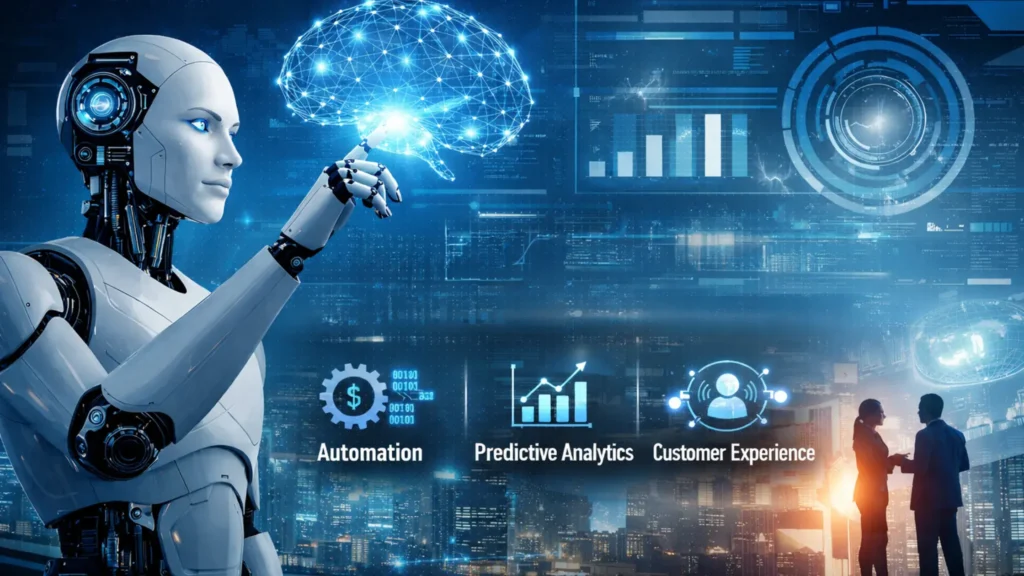
In 2025 alone, over 77% of businesses either use or actively explore AI in business operations. Yet, while AI adoption is accelerating, many modern businesses still struggle to apply advanced AI technologies strategically.
Artificial intelligence is no longer just a future idea; it is now essential for staying competitive.
Advanced AI technologies are changing how businesses work, compete, and grow. They use predictive analytics for better decision-making and automation to cut operational costs. The main question for business leaders is not whether AI is important, but how they can use it effectively.
Modern business owners face mounting pressure: rising operational costs, increasing customer expectations, data overload, and fierce competition. Without intelligent systems in place, scaling becomes inefficient and risky.
This blog explores how advanced AI technologies are transforming modern businesses, the key technologies behind this shift, real-world industry applications, common challenges, and how Everite Solutions helps businesses unlock AI-driven growth.
The Growing Importance of Advanced AI Technologies in Modern Businesses
Advanced AI technologies are smart systems. They use machine learning, natural language processing, predictive analytics, and automation tools. These technologies help businesses work more quickly and effectively.
Unlike traditional software, AI systems learn from data, adapt over time, and generate insights that humans alone cannot easily identify.
For modern businesses, this means:
- Faster and data-driven decision-making
- Improved customer experience through personalization
- Reduced operational costs through automation
- Better risk management
- Competitive advantage in dynamic markets
However, many companies struggle with implementation due to unclear strategy, integration challenges, and skill gaps.
The Key Roles of AI in Business Transformation
Automation: Streamlining Repetitive Tasks
One of the most immediate impacts of AI in business is automation.
Modern businesses often waste valuable human resources on repetitive tasks such as:
- Data entry
- Invoice processing
- Inventory updates
- Customer query handling
- Report generation
Robotic Process Automation (RPA) and intelligent automation systems eliminate these inefficiencies.
Benefits of AI-driven automation include:
- Reduced operational costs
- Fewer human errors
- Faster processing times
- Higher employee productivity
By automating repetitive tasks, companies help their teams focus on important projects instead of routine work.
Decision-Making: Predictive Analytics for Smarter Strategies
Data is abundant. Insight is rare.
Advanced AI technologies leverage predictive analytics to turn raw data into actionable intelligence. Instead of relying on intuition, businesses can:
- Forecast demand
- Identify high-value customers
- Predict churn
- Optimize pricing strategies
- Reduce financial risks
Machine learning models analyze historical patterns and provide predictive insights that help leaders make informed decisions with greater confidence.
For modern businesses operating in competitive markets, predictive analytics is not just an advantage — it’s a survival tool.
Customer Experience: Personalization at Scale
Customers today expect experiences that are tailored to them. AI systems analyze how users behave, what they buy, and how they engage with brands to offer:
- Personalized product recommendations
- Dynamic pricing
- Customized email campaigns
- Smart chatbots
- Real-time support
Improving the customer experience leads to more engagement, better retention, and stronger brand loyalty.
Businesses that integrate AI into their customer journey consistently outperform competitors in both revenue and customer satisfaction.
Key Advanced AI Technologies Driving Business Innovation
Machine Learning (ML)
Machine learning is the foundation of advanced AI technologies.
Machine learning algorithms learn from data and get better over time without needing specific instructions. Many businesses today use machine learning (ML) for several key purposes:
- Detecting fraud
- Predicting sales
- Creating recommendation engines
- Assessing risk
- Performing predictive maintenance
ML helps companies quickly analyze large amounts of data, allowing them to make decisions based on solid information.
Natural Language Processing (NLP)
Natural Language Processing enables machines to understand and interpret human language.
Applications include:
- AI chatbots
- Sentiment analysis
- Automated email responses
- Voice assistants
- Document analysis
NLP improves communication between businesses and customers while reducing response times and operational strain.
Robotic Process Automation (RPA)
RPA automates rule-based, repetitive tasks across business functions.
In finance departments, RPA can:
- Process invoices
- Reconcile accounts
- Generate compliance reports
In HR, it can:
- Automate onboarding workflows
- Manage payroll systems
RPA increases operational efficiency while maintaining consistency and accuracy.
Generative AI
Generative AI is transforming content creation, design, and innovation.
Modern businesses use generative AI for:
- Marketing content creation
- Code generation
- Product design simulations
- Customer interaction scripts
When implemented strategically, generative AI enhances productivity and innovation across departments.
Industry Applications of Advanced AI Technologies
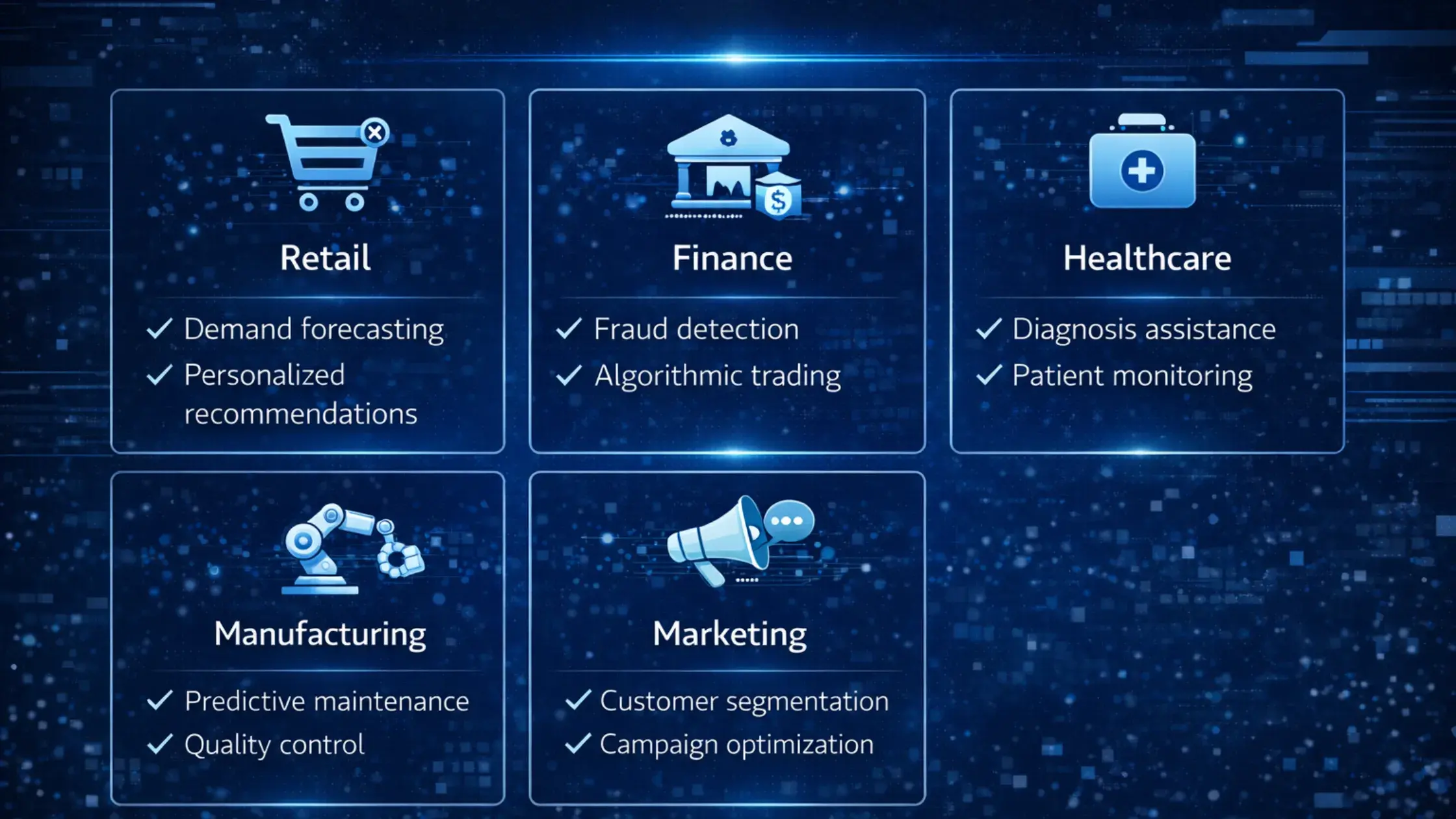
AI adoption spans multiple industries:
Retail:
- Inventory optimization
- Personalized shopping experiences
- Demand forecasting
Finance:
- Fraud detection
- Risk modeling
- Automated trading strategies
Healthcare:
- Diagnostic support
- Patient data analysis
- Workflow automation
Manufacturing:
- Predictive maintenance
- Supply chain optimization
- Quality control
Marketing:
- Behavioral targeting
- Campaign performance prediction
- Customer segmentation
These applications demonstrate how advanced AI technologies enable operational efficiency and strategic advantage.
Challenges Modern Businesses Face with AI Adoption
Despite its benefits, AI implementation comes with challenges:
Data Privacy:
Handling sensitive customer data requires strong governance and compliance.
Bias and Ethics:
AI models must be monitored to prevent discriminatory outcomes.
Integration Complexity:
Legacy systems may not integrate seamlessly with AI tools.
Skill Gaps:
Businesses often lack in-house AI expertise.
Scalability Concerns:
Poorly implemented AI solutions may not scale efficiently.
This is where strategic guidance becomes essential.
How Everite Solutions Helps Businesses Leverage Advanced AI Technologies
At Everite Solutions, we help modern businesses move beyond experimentation toward strategic AI adoption.
Our approach focuses on:
- Identifying high-impact AI use cases
- Designing scalable AI strategies
- Integrating machine learning and automation solutions
- Ensuring ethical and secure AI implementation
- Training teams for long-term success
We do not just implement AI — we align it with business objectives to drive measurable results.
Key Takeaways
- Advanced AI technologies are reshaping modern businesses across industries.
- Automation reduces costs and increases operational efficiency.
- Predictive analytics enhances strategic decision-making.
- AI-driven personalization improves customer experience.
- Successful AI adoption requires strategy, governance, and expertise.
- Partnering with experienced consultants accelerates results while minimizing risks.
Conclusion
Advanced AI technologies are no longer optional for modern businesses seeking growth, efficiency, and competitive advantage.
Automation, predictive analytics, machine learning, and generative AI are changing how businesses operate, engage with customers, and plan for the future.
However, successful implementation requires more than tools — it requires vision, integration, and expertise.
Partner with Everite Solutions to leverage AI for growth and efficiency. Let us help you transform intelligence into impact.
Frequently Asked Questions
- What are advanced AI technologies?
Advanced AI technologies include machine learning, predictive analytics, automation, NLP, and generative AI that help modern businesses improve efficiency, decision-making, and customer experience. - How does AI in business improve performance?
AI streamlines operations through automation, enhances decision-making with predictive analytics, and improves customer experience through personalization. - Can small and mid-sized businesses use AI?
Yes. Modern AI tools are scalable and can help businesses of all sizes reduce costs, increase productivity, and gain a competitive advantage. - What industries benefit from AI the most?
Retail, finance, healthcare, manufacturing, and marketing see significant impact through automation, analytics, and customer insights.