

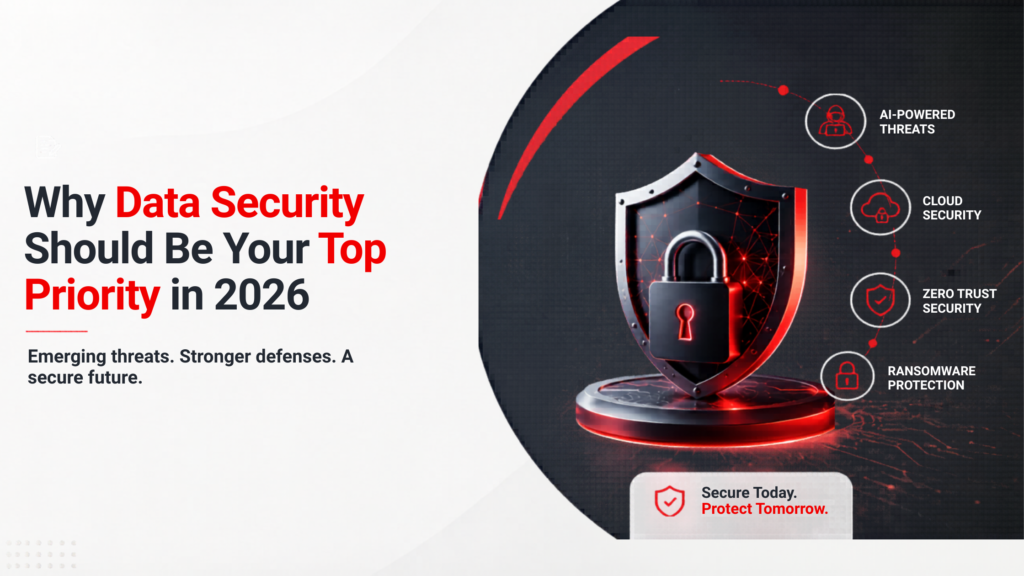
Introduction: The Stakes Have Never Been Higher
Every 39 seconds, a cyberattack occurs somewhere in the world. By 2026, the global cost of cybercrime is projected to surpass $10.5 trillion annually — a figure that dwarfs the GDP of most nations. For business owners, CTOs, CIOs, IT managers, and enterprise leaders, that number isn’t just a statistic. It’s a warning.
Data security in 2026 is no longer a back-office concern managed quietly by IT departments. It’s a boardroom imperative. It shapes how companies earn customer trust, maintain regulatory compliance, attract investors, and ultimately survive in an increasingly hostile digital environment.
The threat landscape has fundamentally shifted. Attackers are more sophisticated. Their tools are powered by artificial intelligence. Their targets — your cloud environments, your remote workforce, your third-party vendors — are more exposed than ever before.
This guide explains why data security deserves your full attention now, outlines the threats you’re facing, and provides specific steps you can take to protect your business. Whether you’re a startup founder or an enterprise decision-maker, the information here is directly relevant to your organization’s future.
1. The Escalating Cyber Threat Landscape in 2026
The threat environment businesses face in 2026 is markedly different from what it was even two years ago. The convergence of AI, cloud computing, geopolitical tensions, and a sprawling remote workforce has created a perfect storm for cybercriminals.
Ransomware Attacks: Bigger, Bolder, Costlier
Ransomware remains the single most disruptive form of cyberattack for businesses of all sizes. Modern ransomware groups operate like professional enterprises — complete with customer service teams, negotiation protocols, and affiliate programs. The average ransomware payment now exceeds $1.5 million, and this figure doesn’t account for the weeks of downtime, lost productivity, and reputational damage that often follow.
Notable recent ransomware incidents have crippled hospital systems, disrupted supply chains, and brought major manufacturing lines to a halt — all within hours of initial infection.
Phishing Threats: The Human Vulnerability
Phishing remains the most common entry point for data breaches, accounting for over 36% of all incidents globally. In 2026, AI-generated phishing emails are virtually indistinguishable from legitimate communications. Attackers craft personalized messages — using scraped LinkedIn data, public records, and company websites — to deceive even security-aware employees.
Spear phishing, whaling (targeting executives), and voice phishing (vishing) have all grown in sophistication and frequency.
Insider Threats: The Enemy Within
Not every breach comes from the outside. Disgruntled employees, careless contractors, and negligent staff with excess access permissions pose significant risks. Insider threats account for approximately 19% of all data breaches, and they are often far harder to detect than external attacks because they exploit legitimate credentials.
Third-Party and Supply Chain Risks
Your security posture is only as strong as your weakest vendor. Attackers increasingly target smaller, less-protected third-party suppliers to gain access to their larger enterprise clients. The ripple effect of a single compromised vendor can impact hundreds of downstream businesses.
2. AI-Powered Cyberattacks: The New Frontier of Risk
Artificial intelligence is a double-edged sword in cybersecurity. While defenders use it to detect anomalies and automate threat response, attackers weaponize it to scale their operations and bypass traditional defenses.
How AI Is Being Used Against Businesses
- Automated vulnerability scanning: AI tools can probe thousands of systems for weaknesses in minutes, identifying exploitable gaps before human defenders can respond.
- Deepfake social engineering: AI-generated voice and video are being used to impersonate executives, authorizing fraudulent wire transfers and data disclosures.
- Polymorphic malware: AI-generated malware changes its signature continuously, evading antivirus and signature-based detection tools.
- Credential stuffing at scale: AI accelerates brute-force attacks on login portals, using leaked credentials from one breach to infiltrate dozens of other platforms.
Understanding the role of AI in the evolving threat landscape is critical for any enterprise cybersecurity strategy in 2026. Learn how AI-powered security and encryption can be a part of your defense strategy with EVERITE Solutions.
3. The Financial and Reputational Impact of a Data Breach
The consequences of inadequate data security are devastating — and they extend far beyond the immediate cost of a breach.
Direct Financial Losses
- Average cost of a data breach in 2024: $4.88 million (IBM Cost of a Data Breach Report)
- Average cost of downtime per hour: $300,000 or more for enterprise organizations
- Regulatory fines: GDPR fines can reach up to €20 million or 4% of global annual turnover; CCPA and other regional laws carry similarly severe penalties
Reputational Damage
Trust, once lost, is nearly impossible to rebuild. Studies show that 60% of small and medium businesses fail within six months of a major cyberattack. For larger enterprises, a public breach triggers stock price drops, customer churn, partner withdrawals, and years-long reputational recovery efforts.
Legal Liability
Increasingly, breached organizations face class-action lawsuits from affected customers and employees. Board members and C-suite executives are being held personally liable for cybersecurity failures in some jurisdictions, elevating data protection from an IT function to a fiduciary responsibility.
4. Cloud Security and the Remote Work Reality
The shift to cloud-first infrastructure and distributed work models has fundamentally changed the attack surface for most businesses. Data no longer sits behind a secure corporate perimeter — it travels across home networks, personal devices, public Wi-Fi connections, and dozens of SaaS platforms.
Key Cloud Security Challenges in 2026
- Misconfigured cloud storage: Open S3 buckets and misconfigured permissions remain a leading cause of data exposure.
- Shadow IT: Employees using unauthorized cloud applications create invisible security gaps that IT teams cannot monitor or protect.
- Shared responsibility confusion: Many organizations misunderstand that cloud providers secure the infrastructure, but you are responsible for securing your data, applications, and access controls.
- Weak password and credential management: Reused, simple, or shared passwords remain alarmingly common, making cloud accounts easy targets.
Protecting your cloud environment requires a proactive, layered approach. EVERITE Solutions offers dedicated cloud security and infrastructure services designed to close these gaps and keep your data safe. Our team also provides deep guidance on preventing data breaches in cloud environments with proven frameworks.
5. Compliance, Regulations, and Data Privacy Laws in 2026
Regulatory pressure on data security has intensified globally. For enterprises operating across borders — or handling sensitive customer data — compliance is no longer optional.
Key Regulations to Know
- GDPR (Europe): Strict data processing, consent, and breach notification requirements with massive penalty exposure.
- CCPA / CPRA (California): Enhanced consumer privacy rights, opt-out requirements, and enforcement actions.
- DPDP Act (India): India’s Digital Personal Data Protection Act introduces new obligations for businesses processing Indian citizens’ data.
- NCA / ADHICS (UAE): The UAE’s National Cybersecurity Authority frameworks mandate robust security controls for businesses operating in the region.
- HIPAA (Healthcare, USA): Strict protections for health data with substantial breach notification requirements.
- PCI DSS (Payment Industry): Mandatory security standards for any organization handling cardholder data.
Non-compliance carries not just financial penalties, but the risk of losing operating licenses and the ability to conduct business in key markets. EVERITE Solutions helps businesses achieve and maintain security and compliance in the cloud, ensuring your operations meet the latest regulatory standards across the USA, UAE, and India.
6. Why Zero Trust Security Is Essential in 2026
The traditional “castle-and-moat” security model — where everything inside the network is trusted and everything outside is not — is fundamentally obsolete in a cloud-native, remote-work world.
Zero Trust Security operates on a single, powerful principle: never trust, always verify.
Core Principles of Zero Trust
- Verify every user, every device, every time — regardless of location or prior authentication
- Apply least-privilege access — users and systems only access what they need, nothing more
- Assume breach — design systems as if attackers are already inside; limit lateral movement
- Continuous monitoring — authenticate and authorize every request in real time
Why Zero Trust Matters for Your Business
Zero Trust architecture dramatically reduces the blast radius of any breach. If an attacker compromises one account, they cannot freely move laterally across your systems. It also makes insider threats far more difficult to execute and significantly easier to detect.
Implementing Zero Trust typically involves Identity and Access Management (IAM) systems, multi-factor authentication (MFA), micro-segmentation, and robust endpoint security — all of which EVERITE Solutions can design and deploy for your organization.
7. Cybersecurity Best Practices Every Business Should Implement Now
Protecting your organization’s data doesn’t require a complete technology overhaul overnight. Start with these foundational practices and build from there.
Technical Controls
- Multi-Factor Authentication (MFA): Require MFA on every account — especially email, cloud services, and administrative portals. MFA blocks over 99.9% of account compromise attacks.
- Endpoint Security: Deploy advanced endpoint detection and response (EDR) tools on every device connecting to your network, including personal devices used for work.
- Encryption: Encrypt data at rest and in transit. Encryption ensures that even if data is stolen, it remains unreadable to attackers. Learn how EVERITE uses AI-powered encryption and data masking to protect enterprise data.
- Identity and Access Management (IAM): Implement role-based access control (RBAC) to ensure employees only access systems relevant to their role.
- SIEM Solutions: Security Information and Event Management (SIEM) platforms aggregate and analyze security data from across your infrastructure, enabling real-time threat detection.
- Patch Management: Apply security patches and software updates promptly. Unpatched vulnerabilities are the #1 vector for ransomware attacks.
- Backup and Disaster Recovery: Maintain encrypted, air-gapped backups of all critical data. Test your recovery process regularly — a backup you’ve never tested is not a backup you can trust.
Governance and Process Controls
- Security Audits: Conduct regular internal and third-party security audits to identify weaknesses before attackers do.
- Vendor Risk Management: Assess the security posture of all third-party vendors with access to your data or systems.
- Incident Response Plan: Develop and rehearse a clear incident response playbook so your team knows exactly what to do in the event of a breach.
8. Employee Awareness and Cybersecurity Training
Technology alone cannot solve a human problem. Human error remains the leading cause of data breaches globally — and the solution is continuous, engaging security education.
What Effective Security Training Looks Like
- Phishing simulations: Regular simulated phishing campaigns help employees recognize and report suspicious emails before clicking.
- Security awareness programs: Ongoing training on password hygiene, social engineering tactics, safe browsing, and data handling policies.
- Role-specific training: Finance teams should understand invoice fraud. HR teams should understand data privacy. Executives should understand deepfake and whaling attacks.
- A culture of reporting: Employees should feel safe reporting mistakes or suspicious activity without fear of punishment — catching breaches early is invaluable.
Investing in human awareness is one of the highest-ROI activities in your entire cybersecurity budget.
9. Continuous Monitoring and Threat Detection
The average time to detect a data breach is still 194 days — over six months during which attackers have unrestricted access to your systems, your data, and your customers’ information.
Continuous monitoring closes this window dramatically.
Essential Monitoring Capabilities
- 24/7 Security Operations Center (SOC): Dedicated teams monitoring your environment around the clock for anomalous activity.
- Cloud security monitoring: Real-time visibility into cloud workloads, API calls, configuration changes, and access patterns.
- User and Entity Behavior Analytics (UEBA): AI-powered tools that establish behavioral baselines and flag deviations that may indicate insider threats or compromised accounts.
- Threat intelligence feeds: Continuous integration of external threat intelligence to identify emerging attack vectors before they reach your organization.
- Automated response: SOAR (Security Orchestration, Automation, and Response) platforms that automatically isolate compromised endpoints, block malicious IPs, and initiate forensic collection.
Speed is everything in incident response. Every minute of undetected access compounds the damage.
10. How EVERITE Solutions Strengthens Your Cybersecurity Posture
At EVERITE Solutions, we understand that data security is not a product you buy once — it’s a living discipline that requires strategy, technology, expertise, and continuous evolution.
Serving enterprises across the USA, UAE, and India, EVERITE Solutions delivers end-to-end cybersecurity and cloud security services tailored to your industry, your size, and your risk profile.
What We Offer
- Cloud Security Architecture — Designing secure, compliant cloud environments from the ground up, including secure cloud infrastructure management.
- Compliance Advisory — Navigating GDPR, CCPA, DPDP, NCA, and industry-specific mandates with compliance and cloud security expertise.
- Threat Detection and Response — 24/7 monitoring, SIEM management, and rapid incident response.
- Zero Trust Implementation — IAM, MFA, micro-segmentation, and policy enforcement across your enterprise.
- Data Encryption and Masking — Protecting sensitive data with AI-powered security and encryption solutions.
- Security Audits and Assessments — Identifying and remediating vulnerabilities before attackers find them.
- Backup and Disaster Recovery — Ensuring your business can recover quickly and completely from any incident.
- Digital Transformation with Security Built In — Our strategy and innovation services ensure security is a foundational design principle, not an afterthought.
We don’t just implement technology. We become a strategic partner in your organization’s long-term security journey.
Talk to the EVERITE Solutions team today →
11. Future Trends in Data Security You Need to Watch
The cybersecurity landscape never stands still. Here are the key trends shaping data security strategy beyond 2026.
Post-Quantum Cryptography
Quantum computing threatens to break today’s encryption standards within the next decade. Organizations handling long-lived sensitive data — financial records, health data, government information — must begin planning for post-quantum cryptographic migration now.
AI-Augmented Defense
As AI-powered attacks grow, AI-powered defenses become essential. Machine learning models that predict attack patterns, autonomous threat hunting, and AI-driven vulnerability prioritization will define the next generation of enterprise security.
Cybersecurity Mesh Architecture (CSMA)
Rather than a single security perimeter, CSMA creates flexible, distributed security controls wherever assets reside — enabling consistent policy enforcement across hybrid cloud, on-premise, and edge environments.
Privacy-Enhancing Technologies (PETs)
Tools like homomorphic encryption, differential privacy, and secure multi-party computation allow organizations to derive analytical insights from data without ever exposing the raw data — a critical capability as privacy regulations tighten globally.
Regulatory Expansion
Expect new and expanded data protection laws in emerging markets across Southeast Asia, Latin America, and the Middle East. Global businesses must build regulatory agility into their compliance programs.
Frequently Asked Questions (FAQ)
Q1: What is data security and why is it important in 2026?
A: Data security refers to the policies, technologies, and practices used to protect digital data from unauthorized access, corruption, theft, or loss. In 2026, it is critically important because cyber threats are at unprecedented levels — powered by AI, targeting cloud infrastructure, and capable of causing millions of dollars in damage within hours. Businesses that fail to prioritize data security face financial loss, regulatory penalties, and permanent reputational harm.
Q2: What are the biggest cybersecurity threats businesses face in 2026?
A: The most significant threats include AI-powered ransomware attacks, sophisticated phishing and spear phishing campaigns, insider threats, third-party supply chain vulnerabilities, cloud misconfigurations, and credential-based attacks exploiting weak or reused passwords.
Q3: What is Zero Trust security and does my business need it?
A: Zero Trust is a security model built on the principle of “never trust, always verify.” It requires continuous verification of every user, device, and connection — regardless of whether they’re inside or outside your network. In 2026, with remote work and cloud adoption mainstream, virtually every business benefits from Zero Trust principles to limit unauthorized access and reduce breach impact.
Q4: How can small and medium businesses (SMBs) improve data security on a limited budget?
A: SMBs should prioritize multi-factor authentication (MFA), regular employee security training, cloud backup and disaster recovery, software patching, and working with a managed security service provider (MSSP). Many enterprise-grade security tools are now available at SMB-friendly pricing, and the cost of prevention is always far lower than the cost of a breach.
Q5: What compliance regulations apply to my business in 2026?
A: The regulations that apply depend on your industry, geography, and the type of data you handle. Common frameworks include GDPR (Europe), CCPA/CPRA (California), HIPAA (healthcare), PCI DSS (payments), DPDP Act (India), and UAE’s NCA cybersecurity requirements. EVERITE Solutions can conduct a compliance gap analysis to identify exactly which regulations apply to your organization.
Q6: How does EVERITE Solutions help with data security?
A: EVERITE Solutions provides comprehensive cybersecurity services including cloud security architecture, Zero Trust implementation, compliance advisory, 24/7 threat monitoring, data encryption, security audits, and disaster recovery planning. Serving clients across the USA, UAE, and India, EVERITE helps businesses build robust, scalable security postures aligned with their unique risk profiles. Contact our team to get started.
Q7: How often should a business conduct a security audit?
A: Security audits should be conducted at minimum annually, and ideally every six months for organizations in regulated industries or those handling large volumes of sensitive data. Additionally, audits should be triggered after major infrastructure changes, new vendor onboarding, or any security incident.
Q8: What is the average cost of a data breach in 2024–2025?
A: According to IBM’s Cost of a Data Breach Report, the global average cost of a data breach reached $4.88 million in 2024 — the highest ever recorded. This includes direct costs such as incident response, legal fees, and regulatory fines, as well as indirect costs including lost business, customer churn, and reputational recovery.
Conclusion: The Time to Act Is Now
Data security in 2026 is not a future challenge — it is an immediate, daily reality. The threats are real, the consequences are severe, and the organizations that treat cybersecurity as a strategic priority will be the ones that survive and thrive in this environment.
The good news is that effective protection is achievable. With the right partner, the right technology stack, and a culture of security awareness, your business can significantly reduce its risk exposure, meet regulatory requirements, and build the kind of trust that drives long-term growth.
EVERITE Solutions is that partner. With deep expertise across cloud security, compliance, Zero Trust architecture, and AI-powered threat detection, we help businesses across the USA, UAE, and India build digital infrastructure that is not just powerful — but secure.
Don’t wait for a breach to take security seriously. The cost of prevention will always be lower than the cost of recovery.
🔐 Ready to Secure Your Business?
Schedule a Free Security Consultation with EVERITE Solutions →
Whether you’re looking to assess your current security posture, achieve compliance, or build a Zero Trust architecture from the ground up — our team is ready to help.